Ice Baths and Your Menstrual Cycle: What to Know Before You Plunge
Quick Answer: Cold exposure is generally considered safe throughout the menstrual cycle for healthy individuals, but body temperature regulation and cold tolerance can shift somewhat across cycle phases due to hormonal changes — many people report cold plunges feeling more intense or less tolerable during the luteal phase, when core body temperature naturally runs slightly higher, making the same water temperature feel like a bigger contrast.
This is general information, not medical advice — anyone with a specific medical condition or concern should check with a doctor before starting a cold exposure practice around any part of their cycle.

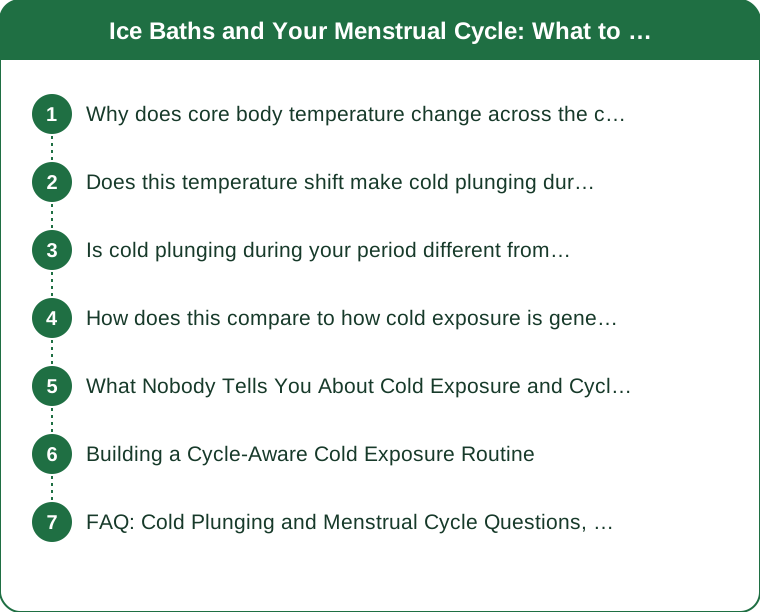
Why does core body temperature change across the cycle in the first place?
Progesterone, which rises after ovulation during the luteal phase, has a thermogenic effect that raises baseline core body temperature by roughly 0.5°F on average. This is actually the physiological basis for fertility tracking methods that monitor basal body temperature — and it’s directly relevant to cold exposure, since a higher starting temperature changes how a given cold stimulus is experienced by the body.
That half-degree shift sounds small, but combined with the intensity of cold water immersion, many people notice it as a genuinely different sensation, not just a subtle one.
Does this temperature shift make cold plunging during the luteal phase riskier?
Not inherently riskier for most healthy people, but it can make the same water temperature and duration feel more intense or harder to tolerate, which is worth planning around rather than pushing through. Reducing plunge duration or choosing a slightly less extreme water temperature during this phase is a reasonable, low-effort adjustment many people make once they notice the pattern.
Listening to your subjective tolerance on a given day matters more here than following a fixed protocol regardless of how the body is responding that week.
Is cold plunging during your period different from other days?
There’s no strong evidence that cold exposure during menstruation itself is unsafe, and some people report that cold plunges help with period-related cramping or bloating, similar to how a cold compress is sometimes used locally, though this specific full-body benefit isn’t heavily studied. Individual comfort varies significantly, and some people simply prefer to skip or shorten a plunge during the first day or two of their period for comfort reasons rather than any safety concern.
Hygiene products (a tampon or menstrual cup) generally make cold plunging during a period logistically comparable to swimming, without additional special preparation needed.

How does this compare to how cold exposure is generally timed around workouts?
Separate from cycle timing, cold exposure timing around workouts already has its own considerations — cold immersion immediately after strength training can blunt some muscle-building adaptations if done too soon after lifting, which is a reason some people plunge on non-lifting days or wait several hours post-workout regardless of cycle phase. Layering cycle-awareness on top of this existing workout-timing guidance means the luteal phase might be a good window to choose a lighter plunge protocol on a day that’s already lower-intensity training-wise, combining both considerations into one simpler weekly rhythm.
What Nobody Tells You About Cold Exposure and Cycle Tracking
Most cold plunge guides are written without any mention of the menstrual cycle at all, treating cold tolerance as a fixed, trainable trait rather than something that fluctuates with normal hormonal changes. That gap means a lot of people interpret a harder-than-usual plunge day during the luteal phase as a sign they’re ‘losing’ cold tolerance or having an off day, when it’s actually a predictable, temporary physiological shift.
Tracking cycle phase alongside cold exposure tolerance for even one full cycle — noting duration, water temperature, and subjective difficulty — often reveals a clear pattern that reframes what felt like inconsistent progress into something explainable and easy to plan around.
Building a Cycle-Aware Cold Exposure Routine
A practical approach many people land on: keep plunge duration and temperature closer to personal baseline during the follicular phase (right after the period through ovulation), when tolerance often feels most consistent, and be willing to shorten duration or raise the water temperature slightly during the luteal phase without treating it as a setback. This isn’t about avoiding cold exposure during any particular phase — it’s about adjusting the dose to match what the body is actually managing that week, similar to how training intensity is often adjusted around other forms of fatigue or stress.
Over a few cycles, this kind of tracking tends to build a genuinely personalized protocol that’s more sustainable than following a single fixed routine regardless of where you are in your cycle.
FAQ: Cold Plunging and Menstrual Cycle Questions, Answered
Is it unsafe to cold plunge on the heaviest day of a period?
There’s no established safety concern specific to flow heaviness, though personal comfort (cramping, fatigue) may make a shorter or skipped session more appealing on the heaviest day — this is a comfort preference, not a documented risk.
Does hormonal birth control change this pattern?
Hormonal birth control can flatten the natural progesterone rise that drives the luteal-phase temperature shift, so people on certain hormonal birth control methods may notice a less pronounced version of this pattern, or none at all.
Should cold exposure be avoided entirely during any specific cycle phase?
For most healthy individuals, no phase requires full avoidance — the guidance here is about adjusting intensity and duration to match tolerance, not about skipping cold exposure during any particular week of the cycle.
TL;DR:
- Progesterone raises core body temperature slightly during the luteal phase
- That shift can make the same cold plunge feel more intense during that window
- There’s no strong evidence cold exposure is unsafe during any cycle phase, including your period
- Tracking cycle phase alongside plunge tolerance reveals a pattern worth planning around
This is general information, not medical advice — cold exposure tolerance naturally fluctuates with your cycle, and adjusting the dose rather than forcing a fixed routine tends to be the more sustainable approach.
Keep Reading
This article is for general informational purposes only and is not medical advice. Always consult a qualified health professional for guidance specific to you.