The Complete Guide to Breathing During Cold Exposure
Quick Answer: Cold water triggers an involuntary gasp followed by 60 to 90 seconds of rapid uncontrolled breathing. That reflex, not the temperature, is what makes cold exposure frightening and it is the main drowning mechanism in open water. The controllable part is your exhale: enter slowly, breathe out as you submerge, and extend exhales longer than inhales until the reflex passes. Never hyperventilate before entering water - it delays the urge to breathe without adding oxygen and has caused deaths. The reflex fades with repeated exposure over four to six sessions.
Almost all cold exposure guidance treats breathing as a technique to add. It is the actual event. Everything else in a cold plunge is downstream of what your breathing does in the first minute.

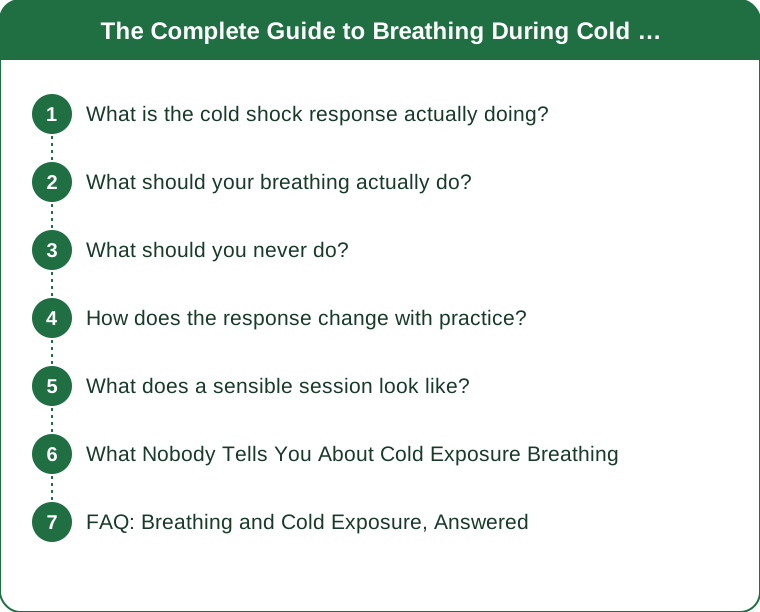
What is the cold shock response actually doing?
It is a reflex, not a reaction you can decide against. Sudden immersion in water below roughly 15 degrees Celsius triggers a cascade mediated by cold receptors in the skin, and it happens whether or not you are mentally prepared.
The first event is an involuntary gasp, typically a deep inhalation of one to three litres. In open water with your face submerged, this is the moment people inhale water, and it is why cold water drowning frequently happens within seconds rather than through exhaustion.
Then comes hyperventilation. Breathing rate can increase several-fold and stays elevated for 60 to 90 seconds. It is uncontrolled, it feels like panic, and it is physiologically driven rather than psychological.
Breath-hold capacity collapses. The time you can comfortably hold your breath drops dramatically in cold water, which matters enormously for anyone in open water.
Heart rate and blood pressure spike simultaneously. Peripheral vasoconstriction pushes blood centrally, raising blood pressure sharply, while cold receptors drive heart rate up. This combination is the reason cold immersion carries genuine cardiac risk for people with heart conditions, and why the biggest single group of cold water deaths is cardiac rather than hypothermic.
The whole response peaks in the first 30 seconds and largely subsides by 90 seconds to two minutes. That is the window you are managing, and understanding that it is short and self-limiting is itself one of the most useful tools for getting through it.
Hypothermia, by contrast, takes far longer than most people assume - typically 30 minutes or more in cold water for a healthy adult. The danger in the first two minutes is the breathing reflex, not the temperature.
What should your breathing actually do?
Enter slowly. This is the largest single lever and it is free. A gradual entry over 20 to 30 seconds allows the cold receptors to fire progressively rather than all at once, and it noticeably reduces the intensity of the gasp.
Exhale as you go in. If you are exhaling at the moment of submersion, the gasp reflex has less to work with, and you are not at risk of a large involuntary inhalation. This single habit is the most effective technique in the entire practice.
Then extend your exhales. Aim for an inhale of roughly three seconds and an exhale of six or more. A long exhale engages parasympathetic activity and directly opposes the sympathetic surge the cold has produced.
Breathe through the nose if you can, mouth if you must. Nasal breathing slows the rate naturally. In the first 30 seconds many people cannot manage it, and that is fine - mouth breathing with a long exhale is far better than nasal breathing you cannot sustain.
Do not try to hold your breath. Breath-holding during the cold shock response raises CO2 rapidly at a moment when your drive to breathe is already dysregulated, and it makes the next breath more urgent and less controlled.
Count if it helps. Counting the exhale gives the mind a task at the exact moment it wants to panic, and it makes the rhythm measurable rather than a feeling.
And accept the first 30 seconds rather than fighting them. You cannot breathe calmly through the peak of the reflex, and expecting to is what turns discomfort into distress. The goal is not calm breathing at second five; it is controlled breathing by second sixty.
What should you never do?
Never hyperventilate before entering water. This is the most important safety point in the whole practice.
Deliberate rapid breathing before immersion - including the breathing protocols popularised alongside cold exposure - lowers blood CO2 without meaningfully raising oxygen. Since CO2 is what drives the urge to breathe, this delays that urge while your oxygen continues to fall normally.
The consequence is shallow water blackout: losing consciousness without warning. There is no sensation of needing to breathe before it happens. People have died doing breathing exercises before or during water immersion, and this is not a rare theoretical risk.
Never do any breathing exercise in or immediately before water. If you use a breathing practice, do it seated, on dry land, well away from the tub, and finish it completely before you approach the water.
Never combine breath-holding with cold immersion.
Never plunge alone if you are new to it, and never in open water without someone present.
And do not enter head first or jump in. A sudden full-body immersion produces the strongest possible gasp, and submerging the face during that gasp is the specific mechanism that kills people in open water.

How does the response change with practice?
It habituates faster than almost any other physiological response, and the change is substantial.
Four to six immersions produce a marked reduction in the gasp and hyperventilation, and this is one of the better-established findings in cold water research. It is not a matter of getting mentally tougher; the reflex itself diminishes.
The habituation is fairly durable but not permanent. It persists for months and fades over a longer break, which is why returning after a summer away feels like starting over.
It is somewhat temperature-specific. Habituating to 12-degree water does not fully prepare you for 4-degree water, though it helps.
Short, frequent exposures habituate better than long infrequent ones. For this specific adaptation, five sessions of one minute beat one session of five minutes.
Cold showers habituate the response partially. They are a legitimate starting point and are meaningfully less intense than full immersion, largely because the head and face are not immersed and the surface area is smaller.
And the seasonal timing matters more than people expect. Outdoor water temperature falls through autumn, so a regular outdoor swimmer stays habituated as the water cools gradually - which is exactly why swimmers who continue through autumn cope with winter water that would be dangerous to someone entering it cold in January. If you are restarting after a summer off, treat yourself as unhabituated regardless of what you managed in spring.
What does a sensible session look like?
Do your breathing preparation on dry land, away from the water, and finish it before you approach.
Two or three slow breaths before entry, no more, and nothing rapid. The aim is composure, not a physiological manoeuvre.
Enter over 20 to 30 seconds, exhaling as you submerge. Feet, legs, hips, then shoulders. There is no benefit to speed.
Keep your head and face out of the water for the first minute, particularly if you are new. Face immersion intensifies the response considerably.
Spend the first 60 to 90 seconds doing nothing but extending your exhale. Do not aim for stillness, do not aim for calm; aim for a longer exhale than inhale.
Once breathing settles, the session properly begins. For most purposes, one to three minutes total in genuinely cold water is enough. Longer is not better and increases risk without adding benefit.
Exit before you start shivering hard, and exit immediately if breathing does not settle after two minutes.
Rewarm gradually with dry clothes and movement, not with a hot shower. Sudden vasodilation after cold immersion can drop blood pressure sharply. And be aware of afterdrop - core temperature continues falling for several minutes after exiting, so the coldest moment often comes ten minutes later on the walk home.
What Nobody Tells You About Cold Exposure Breathing
Your breathing gets worse before it gets better within a single session, and that is normal. People often report a second wave of breathlessness around 45 seconds, as the initial adrenaline drops. Knowing it is coming is most of the management.
Talking makes it harder. Conversation during the first minute forces an irregular breathing pattern at exactly the moment you need a regular one. Social plunging is more difficult than solo plunging for this specific reason.
Cold air compounds cold water. Plunging outdoors on a cold autumn morning means your airway is already cold, and the respiratory response is stronger than the same water temperature indoors. Anyone with asthma or exercise-induced bronchoconstriction should be particularly cautious as the air temperature drops, and should discuss cold exposure with a doctor first.
Caffeine before a plunge makes the response harder to control, since it adds sympathetic activation to a situation already dominated by it.
The response is stronger when you are tired, dehydrated, hungover, or unwell, and the same water can feel dramatically different on different days for reasons that have nothing to do with willpower.
Cold hands and feet before entry make it worse, not better. Warm extremities before you get in.
And the biggest sign to stop is a breathing pattern that does not settle. If you are still gasping at two minutes, get out. That is not a session to push through, and there is no benefit being forfeited by leaving.
Cold immersion is not appropriate for everyone. Heart conditions, high blood pressure, pregnancy, Raynaud’s, asthma, epilepsy, and a number of other conditions all warrant a conversation with a doctor first. This is general information, not medical advice.
FAQ: Breathing and Cold Exposure, Answered
A few questions that come up constantly, answered directly.
Why can I not stop gasping when I get in?
Because it is a reflex mediated by cold receptors in the skin, not a failure of willpower. The controllable parts are the speed of entry and the length of your exhale. Enter over 20 to 30 seconds rather than all at once, breathe out as you submerge, and accept that the first 30 seconds will not be calm. It is self-limiting and it largely subsides by 90 seconds.
Should I do breathing exercises before a plunge?
Not near the water, and never any form of rapid or deep over-breathing. Hyperventilation lowers blood CO2 and delays the urge to breathe without adding meaningful oxygen, which is the mechanism behind shallow water blackout. If you use a breathing practice at all, do it seated on dry land, well away from the tub, and finish it completely before you approach the water.
How long until the cold shock response gets easier?
Four to six immersions produce a marked reduction for most people, and this is one of the better-established findings in cold water research. It is genuine physiological habituation rather than growing tolerance for discomfort. It persists for months and fades over a long break, so returning after a summer away will feel close to starting again.
Is a cold shower enough to get the same effect?
Partially. A cold shower habituates the response to a degree and is a sensible starting point, and it is considerably less intense than immersion - the surface area is smaller and the face is not submerged. If your goal is to prepare for open water, showers help but do not fully substitute.
What should make me get out immediately?
Breathing that has not settled after about two minutes, chest pain or tightness, dizziness, confusion, numbness that spreads, or hard uncontrollable shivering. None of these are things to push through, and there is no benefit forfeited by leaving early.
Does the water temperature change how I should breathe?
The technique is the same and the intensity of the response scales with how cold it is and with how sudden the change is. Water around 15 degrees produces a manageable response for most people; below 10 degrees the gasp is considerably stronger and the case for slow entry and an exhale on submersion becomes much more important.
This is general information, not medical advice. If you have any heart or respiratory condition, are pregnant, or take medication affecting blood pressure or heart rate, speak to a doctor before starting cold exposure.
TL;DR:
- Cold shock is a breathing reflex - an involuntary gasp then 60 to 90 seconds of hyperventilation - and it is the main drowning mechanism in cold water, not hypothermia.
- Enter slowly over 20 to 30 seconds and exhale as you submerge; that single habit is the most effective technique in the practice.
- Extend exhales roughly twice as long as inhales until the reflex passes, and count if it helps.
- Never hyperventilate before or during water immersion - it delays the urge to breathe without adding oxygen and has caused deaths.
- The reflex habituates substantially over four to six sessions, and fades again over a long break.
Get out if breathing has not settled by two minutes, rewarm gradually rather than in a hot shower, and expect the coldest moment to arrive several minutes after you exit. This is general information, not medical advice - cold immersion is not appropriate for everyone.
Keep Reading
This article is for general informational purposes only and is not medical advice. Always consult a qualified health professional for guidance specific to you.