Sauna and Cold Exposure in Autumn: A Complete Timing and Dosing Guide
Quick Answer: For sauna, the best-supported pattern is 15 to 20 minutes at 80 to 90 degrees Celsius, 3 to 4 times a week, ideally not immediately after strength training. For cold, 2 to 5 minutes total at 10 to 15 degrees is enough for the mood and alertness effects, and cold immediately after resistance training may blunt hypertrophy adaptations. Autumn changes both: outdoor water cools fast, and the same duration becomes a much bigger dose.
Autumn is when both practices get interesting. Sauna feels genuinely appealing again, and outdoor water is entering the range where it does something.
It is also when people get the dosing wrong in both directions — too long in cold water that has dropped 8 degrees since August, and sauna sessions placed exactly where they undercut their training.
This is the whole picture: what the evidence supports, how much, when, and what to change as the season turns.
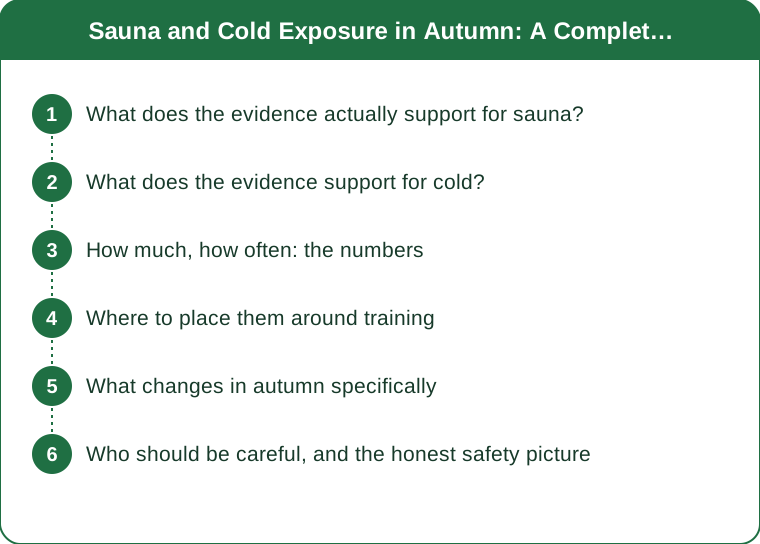
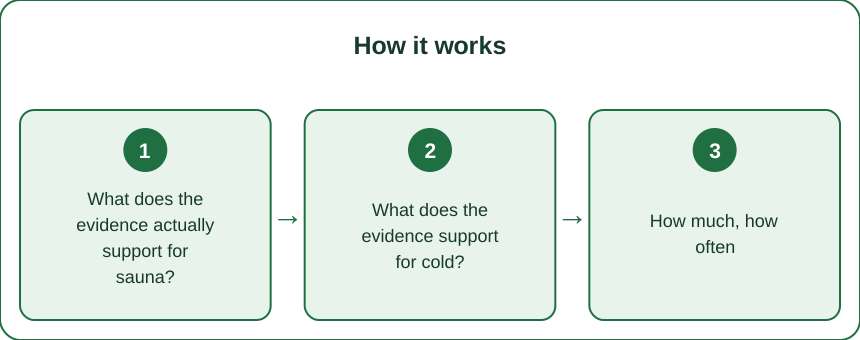
What does the evidence actually support for sauna?
Reasonably strong observational evidence for cardiovascular and all-cause outcomes, and moderate mechanistic evidence for the rest.
The most-cited body of work comes from long-running Finnish cohort studies, which found frequency-dependent associations between sauna bathing and lower cardiovascular and all-cause mortality — with 4 to 7 sessions a week associated with larger reductions than 2 to 3, and those with 1 per week. These are observational, so causation is not established, but the dose-response relationship and the size of the effect have made them influential.
The proposed mechanisms are plausible and measurable. A sauna session raises heart rate to levels comparable with moderate exercise, dilates peripheral blood vessels, and lowers blood pressure acutely. Regular sessions are associated with improved endothelial function and arterial compliance. There is also reasonable evidence for plasma volume expansion and heat-shock protein induction, which underpins the use of sauna for heat acclimation in athletes.
For recovery and soreness, the evidence is weaker and mixed. For sleep, the evidence is largely indirect but mechanistically sensible: passive heating followed by cooling accelerates the core temperature drop that initiates sleep, and an evening sauna 90 minutes before bed fits that pattern well.
For “detox,” there is no meaningful evidence. Sweat is not an important elimination route for anything you are worried about.
What this adds up to: sauna is well worth doing, mostly for cardiovascular and sleep reasons, at a frequency of 3 or more sessions a week, and it should be treated as a mild cardiovascular stress rather than as rest.
What does the evidence support for cold?
A narrower set of things than the marketing suggests, but the narrow set is real.
Mood and alertness. Cold water immersion produces a large, immediate rise in circulating noradrenaline and dopamine — studies of cold exposure have reported multi-fold increases in noradrenaline. The subjective effect of alertness and elevated mood after a cold immersion is consistent and well described, and it lasts hours. This is the best-supported reason to do it.
Reduced perceived soreness. Cold immersion reliably reduces how sore people feel after hard exercise. Worth knowing that reduced soreness is not the same as improved recovery of function.
Brown fat and metabolic effects. Repeated cold exposure activates brown adipose tissue and increases cold-induced thermogenesis. The metabolic significance in humans is real but modest — this is not a weight-management strategy.
Where it goes wrong: cold immediately after resistance training. Multiple studies now indicate that cold water immersion soon after strength training attenuates the anabolic signalling and, over training blocks, the gains in muscle mass and strength. The mechanism appears to relate to blunting the inflammatory signalling that drives adaptation. This is one of the clearer practical findings in the area, and it is routinely ignored.
Endurance training appears less affected, and cold may help when the priority is repeated performance within 24 hours — a tournament, a stage race — rather than long-term adaptation.
Dose: for the mood effects, 2 to 5 minutes total at 10 to 15 degrees is sufficient. Longer is not better and carries real risk.
How much, how often: the numbers
Sauna. Traditional dry sauna at 80 to 90 degrees Celsius, 15 to 20 minutes per session, 3 to 4 times a week as a solid target. If you are new, start at 8 to 10 minutes at a lower bench and build. Multiple shorter rounds with cooling between them — say 3 rounds of 8 minutes — are a well-established alternative and easier to tolerate.
Infrared runs much cooler, typically 45 to 60 degrees, and produces a lower cardiovascular load for a given time. It is not equivalent to traditional sauna at the same duration; expect to need longer, and do not assume the Finnish cohort findings transfer directly.
Cold. 10 to 15 degrees Celsius for 2 to 5 minutes, or around 5 degrees for 1 to 3 minutes. Two to four times a week is plenty. Total weekly cold exposure in the range of 11 minutes has been suggested as a reasonable target from the available literature, which is far less than most enthusiasts do.
Contrast. If alternating, the general pattern is hot first, then cold, finishing on cold for alertness or on warm for sleep. 3 to 4 cycles is typical. There is little evidence contrast is superior to either alone, so choose it for enjoyment rather than expecting an additive effect.
Never alone in cold water, and never after alcohol. Cold water shock response is a genuine drowning risk independent of swimming ability.
A note on frequency versus duration, because people habitually get this backwards in both practices. For sauna, the Finnish data suggests frequency carries the dose-response, not session length — four 15-minute sessions a week appears more favourable than one 60-minute session. For cold, the alertness and mood response is triggered largely in the first 60 to 90 seconds of immersion, and extending from 3 minutes to 12 does not multiply the benefit. In both cases, the sustainable weekly pattern is the variable that matters, and a session short enough that you will actually do it four times beats a heroic one you do once and then avoid.
Practical scheduling that works for most people: two sauna sessions on rest days, one after an easy endurance session, and cold on two mornings — separated from any strength work. That fits into an ordinary week without requiring anything to be rearranged around it, which is the main reason people abandon these practices.
Where to place them around training
This is where most of the practical value lies.
Sauna after strength training: fine, and possibly helpful, but wait 30 to 60 minutes and rehydrate first. Immediately after a hard session you are already dehydrated and vasodilated, and the combination causes more dizziness than benefit.
Cold after strength training: avoid within about 4 hours if muscle growth or strength is the goal. If you want the cold, do it in the morning, on a rest day, or before training rather than after.
Cold before training: acceptable and sometimes useful for alertness, but avoid immediately before heavy lifting — cold muscle is stiffer and produces less force, and the coordination cost is real.
Sauna on rest days: an excellent slot, and where the cardiovascular benefit accrues without any interference.
Sauna for heat acclimation: after easy endurance sessions, 20 to 30 minutes, for 5 to 10 consecutive days. This is the protocol with the best evidence for plasma volume expansion and performance benefit, and it is worth knowing if you have a hot race.
Evening sauna for sleep: 90 minutes before bed. Close enough that the core temperature drop coincides with your sleep onset, far enough that you are not still overheated.
Cold in the evening: usually a mistake if you sleep poorly. The noradrenaline response is not what you want at 9pm.
What changes in autumn specifically
Everything about the cold side, and one thing about sauna.
Outdoor water temperature falls fast and lags the air. A lake or sea that was 19 degrees in late August is often 14 to 15 by late September and can be below 12 by mid-October. The same 5-minute swim is a very different physiological dose, and this is the single most common autumn mistake — people keep their summer duration as the water drops.
The rule to adopt: as the water drops, cut the time. A rough working guide is roughly one minute of immersion per degree of water temperature for unacclimatised swimmers as a ceiling — so 12-degree water means a few minutes, not fifteen. Get out before you want to, and judge by the water temperature you measured today rather than the one you remember.
Afterdrop is the autumn danger. Core temperature continues falling for 10 to 20 minutes after you exit, as cold peripheral blood returns to the core. In summer the air rewarms you. In October, standing on a bank in the wind means the afterdrop is bigger and the shivering starts later. Have dry clothes, a hat and a warm drink ready before you get in, and dress immediately.
Sauna gets easier and more appealing, so people extend sessions. Fine, but hydration is still the limit, and dry heated indoor air means you arrive less hydrated than you did in summer.
Contrast becomes genuinely pleasant, which is the best argument for it.
Who should be careful, and the honest safety picture
This section matters more than the dosing.
Sauna cautions: uncontrolled or unstable cardiovascular disease, recent heart attack, unstable angina, severe aortic stenosis, and pregnancy all warrant medical advice first. Alcohol and sauna is a genuinely dangerous combination and features in a substantial share of sauna-related deaths. Dehydration, certain medications affecting sweating or blood pressure, and standing up suddenly after a session are the practical risks for everyone else.
Cold cautions: cold water immersion causes an involuntary cold shock response — gasping, hyperventilation and a large rise in heart rate and blood pressure in the first 30 to 60 seconds. This is a drowning risk regardless of how well you swim, and it is why entering slowly and controlling your breathing for the first minute matters. Cardiovascular conditions, arrhythmias, uncontrolled hypertension, Raynaud’s and pregnancy all need medical input first.
Never alone in open water. Never after drinking. Never straight in from a hot sauna into deep water. Have an exit plan you can execute while cold and clumsy.
Signs to get out immediately: dizziness, confusion, numbness that spreads, chest discomfort, or losing the ability to control your breathing.
None of this is a reason to avoid either practice. It is the reason to treat both as a dose rather than a competition. The person doing 15 minutes at 4 degrees is not getting more benefit than the person doing 3 — they are just taking more risk.
Everything here is general information and not medical advice. If you have any cardiovascular condition, are pregnant, or take medication affecting blood pressure or thermoregulation, talk to your clinician before starting either.
TL;DR:
- Sauna: 15 to 20 minutes at 80 to 90 degrees, 3 to 4 times a week. Best evidence is cardiovascular and sleep; place it on rest days or 30 to 60 minutes after training.
- Cold: 2 to 5 minutes at 10 to 15 degrees is a full dose. Best-supported benefit is mood and alertness.
- Avoid cold within about 4 hours of strength training — it appears to blunt hypertrophy and strength adaptation.
- Autumn: cut immersion time as water temperature falls, and prepare for a larger afterdrop with dry clothes and a hat ready before you get in.
- Never cold water alone or after alcohol; never sauna after alcohol. Cardiovascular conditions and pregnancy need medical input first.
Set your dose in writing this week — minutes, temperature, and where it sits around training — and then stop increasing it. Both of these practices reward consistency and punish ambition, and autumn is the season that tempts people into the second one.
Keep Reading
This article is for general informational purposes only and is not medical advice. Always consult a qualified health professional for guidance specific to you.