How to Do a Cold Plunge Correctly: A Step-by-Step Guide
Quick Answer: For most people, a correct cold plunge means water at 10 to 15°C, an immersion of 2 to 5 minutes, entering slowly with controlled nasal breathing, keeping the head above water, and rewarming passively afterwards. Total weekly exposure of around 11 minutes is the figure most commonly associated with measurable benefit. Do not plunge immediately after strength training if muscle growth is your goal.
Cold water immersion has gone from an obscure recovery tool to something with a queue outside it. Most of the instruction available is either an anecdote or a temperature with no reasoning attached.
This guide covers the actual protocol — every parameter, why it is set where it is, and what changes it. Read the safety section before you start; it is not decorative.

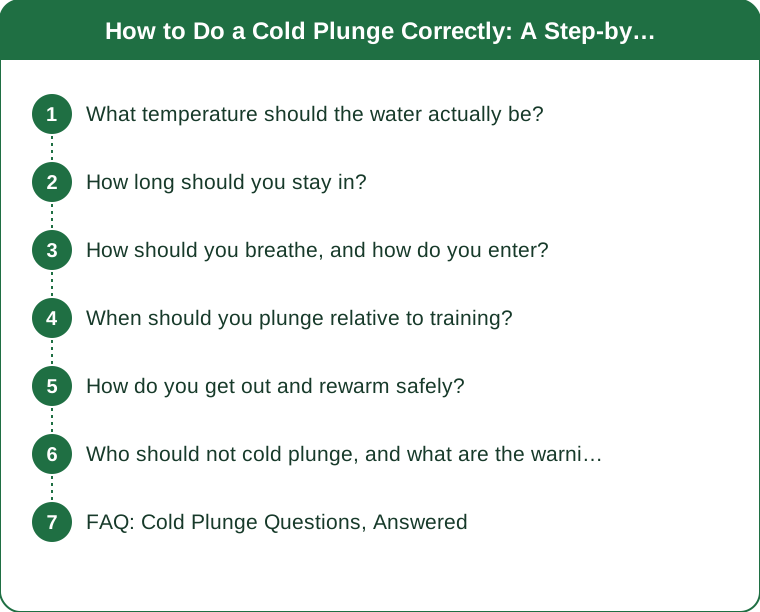
What temperature should the water actually be?
The commonly recommended range is 10 to 15°C (50 to 59°F), and there is good reason for that band rather than colder.
Below about 10°C, the cold shock response becomes considerably more aggressive. Cold shock is an involuntary reaction to rapid skin cooling: an immediate gasp, a period of uncontrollable hyperventilation lasting one to three minutes, a sharp rise in heart rate and blood pressure, and a reduced ability to hold your breath. It peaks around 10 to 15°C water and is dangerous in open water primarily because the gasp reflex can occur underwater. In a controlled tub with your head out, it is unpleasant rather than dangerous — but it makes controlled breathing very difficult, which is where most of the psychological benefit comes from.
Above about 15°C, the stimulus is milder. Physiological responses still occur but are attenuated, and adaptation over weeks means you will need to progress downward to maintain the same effect.
Colder is not proportionally better. Research on recovery and on mood-related outcomes does not show a clean dose-response where 4°C beats 12°C. What colder water reliably produces is a shorter tolerable duration and a higher risk of the two things you want to avoid: uncontrolled breathing and afterdrop.
For beginners, starting at 15°C for a short duration and working down over several weeks is both more sustainable and more pleasant than starting at the coldest water you can find and hating it.
A practical note on measurement: use a thermometer. Water that feels “freezing” is very often 14°C, and estimating by feel means you have no ability to progress deliberately or to reproduce a session.
How long should you stay in?
Two to five minutes for most people, at 10 to 15°C. Beginners should start at 30 to 60 seconds.
The most-cited practical figure comes from a body of work examining weekly exposure rather than single sessions: roughly 11 minutes of total cold immersion per week, split across two to four sessions, is where measurable effects on mood and perceived recovery cluster in the available research. That maps to three sessions of about four minutes, or four sessions of three.
Longer is not better and carries real cost. Beyond about ten minutes at these temperatures, core temperature begins to fall meaningfully in most people, and the rewarming burden afterwards grows disproportionately. The benefits people are usually seeking — the noradrenaline response, the alertness, the perceived recovery, the tolerance training — are largely front-loaded into the first few minutes.
Duration should also scale inversely with temperature. A reasonable working framework:
- 15°C: 5 to 10 minutes
- 12°C: 3 to 6 minutes
- 10°C: 2 to 4 minutes
- Below 8°C: 1 to 3 minutes, experienced users only
Body composition matters more than people expect. Lower body fat means faster core cooling at the same water temperature, so a lean person and a heavier person doing identical protocols are receiving quite different doses. Smaller bodies also cool faster because of surface-area-to-mass ratio.
Time it with a clock, not by feel. Cold distorts time perception substantially in both directions, and “that felt like four minutes” is worthless data.
How should you breathe, and how do you enter?
Breathing is the part that separates a controlled plunge from an ordeal, and it is where most beginners go wrong.
Enter slowly and deliberately. Feet, then lower legs, then sit down over about 20 to 30 seconds. Jumping in triggers a maximal cold shock response — the fastest possible skin cooling produces the strongest gasp and the most severe hyperventilation. A slow entry gives your nervous system a gradient to work with.
Breathe out as you enter, not in. The gasp reflex is an inspiratory response. Deliberately exhaling as the water reaches your chest gives you something to push against.
Then settle into slow nasal breathing with a long exhale. A workable pattern is in through the nose for a count of four, out through the nose or pursed lips for a count of six to eight. The extended exhale increases parasympathetic activity and directly counters the sympathetic surge the cold is producing. Most people find breathing settles by 60 to 90 seconds — that transition is the moment the session becomes usable.
Keep your head and neck out of the water. Head immersion sharply increases cold shock, and for a routine recovery or wellbeing protocol there is no benefit that justifies it.
Keep hands out if they are the limiting factor. Hands and feet contain a high density of cold receptors and are frequently what ends a session early. Resting hands on the rim is a legitimate adjustment, not cheating.
Do not hyperventilate before or during. Breath-holding techniques that involve deliberate hyperventilation must never be combined with water immersion. They lower carbon dioxide, delay the urge to breathe, and have caused fatal shallow-water blackouts. This is the single most important safety rule in this article.

When should you plunge relative to training?
This is the parameter that most affects whether cold water helps or harms your goals, and it depends entirely on what you are training for.
If your goal is muscle growth or strength adaptation: do not plunge within four to six hours of resistance training. The evidence here is reasonably consistent. Cold water immersion immediately after strength work blunts the signalling that drives muscle protein synthesis and satellite cell activity, and studies tracking this over weeks have found reduced gains in strength and muscle size compared with passive recovery. The inflammation you are suppressing is part of the adaptation you are training for.
If your goal is performance recovery between sessions — a tournament, a stage race, two-a-days, a competition weekend — plunge soon after. Here the reduction in soreness, perceived fatigue, and swelling is exactly what you want, because the priority is being able to perform again in 12 hours, not adapting over 12 weeks.
For endurance training, the picture is more forgiving. Cold immersion after endurance work appears to interfere less with aerobic adaptations than with hypertrophy, though the timing principle still applies if a session was specifically intended as an adaptive stimulus.
For general wellbeing, mood, and alertness — plunge in the morning, separated from training. This is the use case where a standalone session makes the most sense, and separating it from workouts removes the interference question entirely.
The simple heuristic: plunge to recover, not to adapt. If today’s session was meant to make you stronger, let the inflammation do its job. If today’s session needs to be followed by another one tomorrow morning, cool down.
How do you get out and rewarm safely?
The exit is the part protocols usually omit, and it contains the main hazard.
Afterdrop is the continued fall in core temperature after you leave the water — typically 15 to 40 minutes of continued cooling, sometimes 0.5 to 1.5°C, as cold blood from the periphery returns to the core. It is why people sometimes feel worst 20 minutes after a plunge rather than during it.
The sequence that manages it:
Get out slowly and carefully. Blood pressure changes and reduced coordination make slips genuinely common. Have a mat or towel down, and never plunge alone if you are new to it.
Dry off completely and immediately, including your head. Evaporation from wet skin continues removing heat efficiently. This is the highest-value 60 seconds of the whole rewarming process.
Dress in layers, starting with the torso. Warming the core is the priority; extremities follow.
Rewarm passively where you can. Gentle movement — walking, light mobility work — generates heat internally and is the safest method. A warm drink helps more psychologically than thermally, but it helps.
Avoid a hot shower immediately. Rapid external rewarming causes peripheral vasodilation, which sends warm blood to cold skin and can accelerate afterdrop as well as cause dizziness. Wait 10 to 20 minutes.
Do not drive for at least 15 minutes. Shivering, reduced dexterity, and impaired concentration are all common in the first quarter hour.
Shivering afterwards is normal and is your body generating heat. Shivering that continues past 30 minutes, or confusion, slurred speech, or clumsiness, means you went too cold or too long — warm up actively and reduce the dose next time.
Who should not cold plunge, and what are the warning signs?
This section matters more than any of the optimisation above, because cold water immersion is one of the few wellness practices with a genuine acute risk profile.
Do not cold plunge without medical clearance if you have: any cardiovascular condition, including known coronary artery disease, arrhythmias, or uncontrolled high blood pressure; a history of stroke; Raynaud’s phenomenon or cold urticaria; epilepsy or any condition causing loss of consciousness; peripheral neuropathy or reduced sensation; or if you are pregnant.
The cardiovascular caution is not theoretical. Cold shock produces a simultaneous surge in heart rate and blood pressure, and peripheral vasoconstriction increases cardiac afterload. In people with underlying cardiac disease this combination has precipitated arrhythmias and cardiac events. This is the primary mechanism of cold water immersion deaths in otherwise-healthy-seeming people, and it happens in the first minute.
Never plunge after drinking alcohol, which impairs both thermoregulation and judgement, or when very fatigued, ill, or significantly underfed.
Never combine breath-holding or hyperventilation techniques with immersion, as noted above.
Never plunge alone as a beginner, and ideally not alone at all in very cold water.
Stop the session immediately for: chest pain or tightness, an irregular or racing heartbeat, severe or persistent shortness of breath, numbness that is not simply cold, dizziness, confusion, or a headache that comes on suddenly.
If you are on medication that affects heart rate or blood pressure — beta blockers, for example — the normal responses to cold are altered and you should discuss this with your prescriber specifically. This is general information, not medical advice, and the medical clearance recommendation is not a formality.
FAQ: Cold Plunge Questions, Answered
Is a cold shower as good as a plunge?
It produces a smaller stimulus, because immersion cools far more surface area far faster, and water conducts heat about 25 times better than air. But a cold shower is genuinely useful, particularly for building tolerance, and it is dramatically more accessible. Two to three minutes at the coldest setting your shower reaches is a reasonable starting practice.
How soon will I notice anything?
Most people report an immediate alertness and mood effect from the first session — that is the noradrenaline response, and it is real and fairly reliable. Tolerance improves noticeably within two to three weeks. Effects on sleep and perceived recovery, where people report them, tend to emerge over a month or more.
Do I need to plunge every day?
No, and there is no evidence that daily is better than three or four times weekly. The commonly used weekly total of around 11 minutes is easier to hit sustainably across three sessions. Daily exposure also drives faster adaptation, which means the same water feels less effective over time.
What if I cannot stop hyperventilating?
Get out. Then next time, enter more slowly, enter on an exhale, and start at a warmer temperature or a shallower depth. Failing to control breathing is a signal that the dose is too aggressive for your current adaptation, not a sign that you need to be tougher.
TL;DR:
- Target 10–15°C, 2–5 minutes, roughly 11 minutes total per week across 2–4 sessions.
- Enter slowly on an exhale, keep your head out, and use long slow nasal exhales until breathing settles around 60–90 seconds.
- Do not plunge within 4–6 hours of strength training if muscle growth is the goal; do plunge soon after when the priority is performing again tomorrow.
- Dry off immediately, rewarm passively, skip the hot shower for 10–20 minutes, and do not drive for 15.
- Never combine breath-holding with immersion, never plunge after alcohol, and get medical clearance with any cardiac condition.
Done properly, a cold plunge is a short, controlled, repeatable stressor with a decent evidence base for mood and recovery. Done as a dare — coldest water available, longest possible hold, jumping straight in — it is a worse version of the same practice with a meaningfully higher risk. The protocol is the point.
Keep Reading
This article is for general informational purposes only and is not medical advice. Always consult a qualified health professional for guidance specific to you.