How Often You Actually Need Cold Plunge or Sauna (It's Probably Less Than You Think)
Quick Answer: Most of the research behind cold plunge and sauna benefits used 2-4 sessions per week, not daily exposure — for general recovery and cardiovascular benefit, that frequency captures most of the measurable benefit without the time and stress cost of a daily habit.
Social media makes daily cold plunging look like table stakes for anyone serious about recovery. But pull up the actual studies behind the headlines, and the protocols behind most of the widely cited benefits look a lot more modest — and more sustainable — than daily practice.

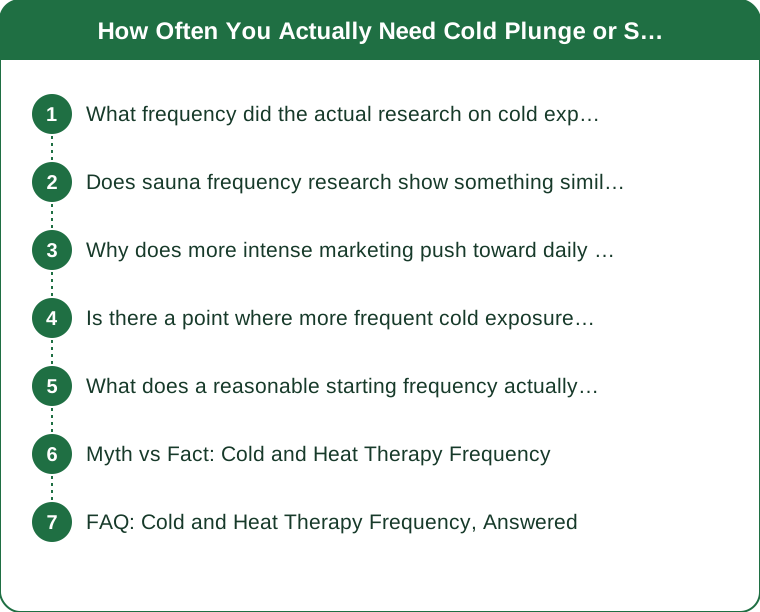
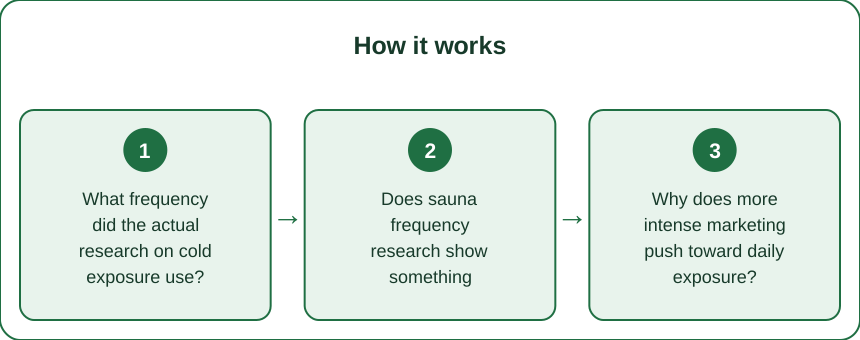
What frequency did the actual research on cold exposure use?
Much of the frequently cited cold-exposure research — including studies on mood, inflammation markers, and cardiovascular adaptation — used protocols in the range of 2-4 sessions per week, often for 2-5 minutes at a time, not daily exposure. Some of the most-cited work on cold water immersion and recovery specifically tested a few sessions weekly, not a daily ritual. That gap between study design and social media practice matters, because the marginal benefit of going from 3 sessions a week to 7 hasn’t been well established in the literature the daily-plunge trend often points back to.
This doesn’t mean daily cold exposure is harmful for most healthy adults — it mostly means the evidence for it being necessary to get the benefit is thinner than the online conversation suggests. If a daily habit genuinely fits your routine and you enjoy it, that’s a reasonable personal choice. But if the daily version feels like a chore, you’re likely not leaving meaningful benefit on the table by scaling back.
Does sauna frequency research show something similar?
Sauna research, particularly the population studies out of Finland that get cited most often for cardiovascular benefit, generally compared frequency bands like 1-3 times per week versus 4-7 times per week, with the higher-frequency group showing somewhat better cardiovascular outcomes in those specific studies. That’s a genuinely different picture from cold exposure — sauna’s benefit curve appears to keep climbing more with frequency, at least in the population data available.
Even there, though, the jump from zero to 2-3 sessions a week appears to capture a large share of the measured benefit, with more modest additional gains from going further. For someone building a new habit, this means 2-3 weekly sauna sessions is a reasonable, evidence-grounded starting target rather than assuming daily is required from day one.
Why does more intense marketing push toward daily exposure?
Content and product marketing around cold plunge and sauna tools has a natural incentive to push more frequent use — more frequent use of a product or habit is generally good for engagement metrics and repeat purchases, independent of whether it’s the evidence-optimal frequency. That doesn’t make daily practice wrong for individuals who like it, but it’s worth separating the marketing incentive from what the underlying research actually supports.
There’s also a genuine self-selection effect in a lot of enthusiast content: people who do these practices daily and post about it tend to already be highly motivated, health-focused individuals — their outcomes reflect a whole lifestyle, not just the frequency of one specific practice.

Is there a point where more frequent cold exposure becomes counterproductive?
For people doing cold exposure specifically around strength training, there’s a more specific concern: research suggests cold water immersion done immediately after resistance training, especially very frequently, may blunt some of the muscle-building adaptation from that training session, likely by dampening the inflammatory signaling that helps drive hypertrophy. This is a more nuanced finding than ‘cold exposure is bad’ — it’s specifically about timing relative to strength training, not a general caution against cold exposure itself.
For general recovery, stress management, or cardiovascular goals unrelated to building muscle, this specific concern is less relevant, and the frequency question becomes more about time cost and personal tolerance than a hard biological ceiling.
What does a reasonable starting frequency actually look like?
Based on the research bands most commonly cited, a reasonable starting point is 2-3 cold exposure sessions and 2-3 sauna sessions per week, each in the 2-15 minute range depending on the modality and your tolerance, rather than defaulting to daily practice from the outset. This captures the frequency range used in most of the foundational research while leaving room to adjust based on how you personally respond and how much time you realistically want to commit.
From there, some people choose to scale up toward more frequent practice because they enjoy it and have the time, and the sauna research in particular suggests there may be some additional benefit to doing so — but scaling up should be a personal choice made after establishing the habit, not an assumption baked in from week one.
Myth vs Fact: Cold and Heat Therapy Frequency
Myth: You need daily cold plunges to see any benefit. Fact: Most of the research behind commonly cited benefits used 2-4 sessions weekly, not daily exposure.
Myth: More sauna sessions are always better with no diminishing returns. Fact: The steepest benefit gain in population studies appears between zero and a few sessions weekly — additional sessions beyond that show more modest incremental gains.
Myth: Cold exposure after any workout is universally beneficial for recovery. Fact: Immediately after resistance training specifically, frequent cold exposure may blunt some muscle-building adaptations — timing matters, not just frequency.
FAQ: Cold and Heat Therapy Frequency, Answered
Is it wasteful to only do cold plunge or sauna once a week?
Not necessarily — even once weekly can provide some benefit, though the research most commonly cited used 2-4 sessions weekly as the range associated with more consistent measurable effects.
Should I avoid cold plunge after every single workout?
The specific concern is around resistance training aimed at building muscle — for cardio sessions or general stress relief, the timing concern is less established, and personal preference can guide the decision.
Does duration matter as much as frequency?
Both matter, but frequency tends to get less attention in casual conversation than duration — a shorter, more frequent practice (within the 2-4x weekly range) is well supported by more of the underlying research than an occasional very long session.
TL;DR:
- Most cited cold-exposure research used 2-4 sessions weekly, not daily practice
- Sauna research shows a steeper benefit curve with frequency, but big gains show up early (a few sessions weekly)
- Cold exposure right after resistance training may blunt some muscle-building adaptation — a timing issue, not a frequency ban
- A reasonable starting point is 2-3 sessions weekly of each, adjusted from there based on personal response
This is general information, not medical advice — check with a doctor before starting cold or heat therapy if you have a cardiovascular condition.
Keep Reading
This article is for general informational purposes only and is not medical advice. Always consult a qualified health professional for guidance specific to you.