The Complete Guide to Heat and Cold Therapy While You Travel
Quick Answer: Travel removes the equipment but not the physiology. Cold showers substitute adequately for plunges when the goal is alertness and mood, hotel tubs can hit useful temperatures with enough ice, and hotel or airport saunas work if you adjust for dehydration from flying. The bigger travel issue is not access - it is that heat and cold both shift core temperature at a time when your circadian rhythm is already disrupted, and timing them badly makes jet lag worse.
The home routine took months to build. Then you spend nine days on the road, the hotel gym has a broken sauna, and the bathtub is the size of a shoebox. Most people just abandon the practice for the trip - which is a reasonable choice, but not the only one.
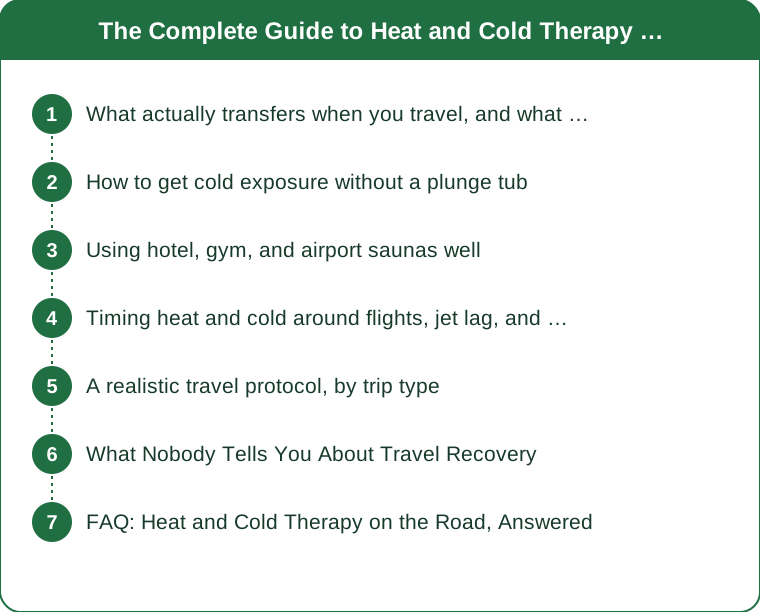
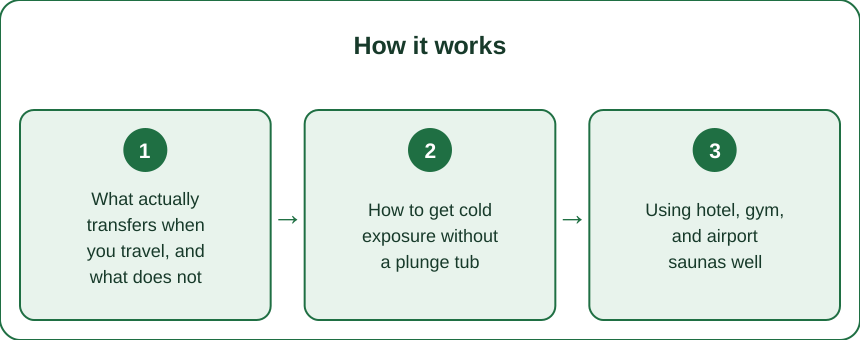
What actually transfers when you travel, and what does not
Start by separating the effects you can reproduce from the ones you cannot.
The effects that travel well
Alertness and mood response to cold. The sharp increase in noradrenaline that makes cold exposure feel mentally clarifying does not require full immersion. A genuinely cold shower for two to three minutes produces a substantial share of that response. This is the single most portable part of the practice, and it happens to be the part most useful on a trip - it is a legitimate tool against mid-afternoon jet-lag fog.
Heat-driven relaxation and sleep support. A hot bath or shower 60-90 minutes before bed drives peripheral vasodilation, which accelerates the drop in core temperature that precedes sleep onset. You do not need a sauna for this. Any hotel with hot water can deliver it, and it is arguably more valuable on the road than at home because sleep is the thing travel damages most.
Muscle relaxation from heat. Warmth increases tissue extensibility and reduces the perception of stiffness. After eight hours in an economy seat, that is worth something regardless of the delivery method.
The effects that do not transfer
Heat adaptation. Genuine adaptation - plasma volume expansion, earlier onset of sweating, lower core temperature at a given workload - requires repeated exposures over one to two weeks at meaningful intensity. A couple of hotel sauna sessions does nothing for it. If you were mid-adaptation before a trip, expect to lose a portion of it and to rebuild on return.
Cold adaptation. The habituation that makes cold water feel tolerable rather than shocking also fades with time away, though it returns faster than it was built. Two weeks off and the first plunge back will feel harder than it did.
Anything requiring precise temperature control. Hotel bathtubs and unfamiliar saunas are not measured environments. Protocols that specify exact temperatures cannot be executed faithfully, and pretending otherwise leads to either uselessly mild sessions or genuinely unsafe ones.
The honest summary: treat travel as maintenance of habit and acute benefits, not as continuation of adaptation. That framing removes most of the frustration.
How to get cold exposure without a plunge tub
Three practical options, in descending order of how well they work.
The ice-filled hotel tub
Most hotel bathtubs hold roughly 100-150 litres when filled to a useful depth. Cold tap water in summer often sits around 18-22C, which is too warm for the response most people are after. Ice from the hotel machine can bring that down, but the volumes involved surprise people - you generally need multiple full ice buckets, and it is a genuinely awkward thing to do in a hotel corridor at 7am.
When it is worth it: longer trips, a hotel with an accessible ice machine on your floor, and a practice you genuinely rely on. When it is not: a two-night trip, or a hotel where the ice machine is in the lobby.
Do not fill a tub with ice and get in without checking the temperature by hand first. Water far colder than you expect produces a cold shock response - an involuntary gasp and hyperventilation - that is dangerous in a bathtub, alone, in a locked bathroom, in a foreign city.
The cold shower
The realistic default. Cold shower water is usually 12-20C depending on the season and the region, which is cold enough to produce a meaningful response and warm enough to be safe for most people without supervision.
How to make it count: get the water genuinely cold rather than lukewarm, aim for two to three minutes, and keep breathing slowly and deliberately through the first thirty seconds, which is when the urge to hyperventilate peaks. Turning your back to the stream and letting the water hit your upper back and neck is more tolerable than a face-first start.
A caveat about hotel plumbing: in older buildings, water temperature can shift abruptly when someone else in the building runs a tap. Stay aware of it rather than closing your eyes and settling in.
Cold water immersion outdoors
Lakes, sea, hotel pools that are unheated in shoulder season. This is where travel gets genuinely risky, because unfamiliar water is the classic setup for accidents. Never swim alone in cold open water, do not enter water whose depth and exit points you have not confirmed, and treat local advice as authoritative over your own experience elsewhere. Cold water incapacitates swimming ability far faster than most people expect - grip strength and coordination degrade within minutes.
If you have any cardiac condition, uncontrolled high blood pressure, or are pregnant, skip cold immersion on the road entirely and use the heat side of the practice instead.
Using hotel, gym, and airport saunas well
Access is usually easier than for cold, and the risks are different.
The dehydration problem specific to travel
Cabin air on a long flight is extremely dry, and most people land already down on fluid. Adding a sauna session on arrival compounds that. The result is not dangerous for a healthy person but it is counterproductive - it worsens the headache and fatigue you were trying to fix.
The rule: rehydrate first, sauna second. Drink properly on landing, wait a few hours, and go in already hydrated. Include some sodium, particularly if you are sweating heavily - plain water alone after a flight plus a sauna is how people end up feeling worse rather than better.
Unfamiliar sauna etiquette
Sauna culture varies enormously by country, and getting it wrong is uncomfortable for everyone. In much of Northern Europe, saunas are nude and often mixed, and wearing swimwear is the faux pas rather than the reverse. In North American gyms, the opposite applies. Sitting on a towel is close to universal. Pouring water on the stones is welcome in some settings and prohibited in others.
The safe default: watch what other people do for a minute before committing, bring a towel, and ask staff if you cannot tell. Nobody minds the question.
Session structure that suits travel
Keep it conservative. Ten to fifteen minutes at a moderate temperature, one or two rounds, is plenty when you are tired, possibly dehydrated, and in an unfamiliar environment. The heroic 20-minute rounds you do at home are exactly the wrong thing to attempt on day one of a trip.
Leave earlier than you think you need to. Dizziness in an unfamiliar sauna, in a building where you do not know where the staff are, is a bad situation. There is no benefit that requires pushing to the edge.
Steam rooms as an alternative
More common in hotel spas than dry saunas, and the humid heat feels considerably more oppressive at a lower temperature. They are fine for relaxation and for the airway comfort many people appreciate after dry cabin air, but the heat stress is harder to gauge, so keep sessions shorter.
Timing heat and cold around flights, jet lag, and training
This is where travel changes the calculus most, and where most people get it wrong.
The jet lag interaction
Your circadian rhythm is anchored partly by core body temperature, which normally falls in the evening and rises in the morning. Both heat and cold exposure shift core temperature meaningfully - which means they can either help you adjust to a new time zone or actively fight the adjustment.
Use heat in the evening of local time. A hot bath or shower 60-90 minutes before your intended local bedtime supports the core temperature drop that precedes sleep, which is exactly the direction you want when you are trying to fall asleep at a time your body thinks is wrong.
Use cold in the morning of local time. A cold shower on waking reinforces the alertness signal and helps anchor the new schedule. It is one of the few genuinely useful jet lag tools that requires no equipment and no planning.
Avoid intense cold late at night in a new time zone. The noradrenaline response is alerting, which is the last thing you need at 11pm local when you are trying to convince your body it is bedtime.
Light matters more than either. Morning daylight exposure is the strongest circadian signal available to you, and no amount of contrast therapy substitutes for it. Use heat and cold as supporting tools around a light-based plan, not instead of one.
Around training on the road
Cold immersion immediately after strength training blunts some of the adaptive response - the inflammatory signalling that cold suppresses is part of how muscle adapts to training. If you are travelling and still training seriously for hypertrophy or strength, leave several hours between the session and any cold exposure, or skip the cold on lifting days.
After endurance work or a competition, cold is more defensible, because the priority shifts from adaptation to being able to perform again soon. Race trips are the clearest case for using cold aggressively.
Heat before training is useful; heat immediately after hard training in an already-hot climate is not. Adding heat stress on top of a session done in the heat is how people end up genuinely unwell on trips.
The long-haul flight itself
Compression, movement every hour or two, and hydration do more for post-flight legs than any recovery protocol on landing. A warm shower on arrival to relax and a cold one the next morning to anchor the schedule is a sensible, low-effort default.
A realistic travel protocol, by trip type
Match the effort to the trip rather than trying to replicate home.
Two to three nights, work trip
Do not attempt anything elaborate. Cold shower on waking, hot shower before bed. That is the entire protocol. It costs nothing, requires no equipment, supports sleep and alertness, and preserves the habit so returning home does not feel like a restart. Anything more ambitious will be abandoned by night two.
One to two weeks, mixed work and leisure
Add sauna access if the hotel or a nearby facility has it, two or three sessions across the trip, kept short. Keep the daily shower routine as the backbone. If there is genuinely cold open water and safe supervised access, that is a legitimate highlight of the trip rather than a training session - treat it as such.
Training camp or race trip
The only case where the ice-bucket bathtub effort is justified. Plan it in advance: confirm ice availability with the hotel before booking, bring a cheap thermometer, and decide the protocol before you are tired and improvising. Post-race cold immersion is the highest-value use of the whole practice and worth real logistical effort.
Extended travel, a month or more
Stop trying to maintain and start rebuilding on arrival. Find a local facility - public saunas, gyms with recovery areas, swimming clubs - and treat it as establishing a new local routine rather than preserving the old one. Adaptation you rebuild in a new place lasts; adaptation you try to preserve through a month of improvisation generally does not.
What to actually pack
Almost nothing. A microfibre towel and a small thermometer if you are serious. Everything else is available or improvisable, and packing recovery equipment for a trip is a reliable way to carry unused weight across three countries.
This is general information, not medical advice. Heat and cold exposure carry real risks for people with cardiovascular conditions, uncontrolled blood pressure, or during pregnancy. Speak to a healthcare professional before starting, and stop immediately if you feel faint, disoriented, or unwell.
What Nobody Tells You About Travel Recovery
The routine matters more than the dose. People who keep a two-minute cold shower daily through a trip return home with the habit intact. People who attempt the full home protocol twice and then quit return home having to rebuild the habit from scratch. The minimum viable version is not a compromise - it is the strategically correct choice.
Most of what you attribute to heat and cold on a trip is actually sleep. Travel wrecks sleep, and sleep drives most of the recovery outcomes people credit to their protocols. If you have limited energy for optimisation on the road, spend it on sleep timing, light exposure, and caffeine cut-off before you spend it on finding a sauna.
Hotel gym saunas are frequently not as hot as advertised. Many run 10-15C below a proper sauna because of usage patterns and maintenance. If a session feels unusually easy, that is why - and it means the session is doing less than you think.
The bathtub ice calculation is worse than you imagine. Melting ice absorbs a large amount of heat, but hotel ice buckets are small and the machine refills slowly. Three trips down the corridor is a realistic expectation, and it is why almost nobody does this twice.
Cold exposure genuinely helps travel anxiety for some people, likely through the same mechanisms that make it useful for mood generally. If flying is stressful for you, a cold shower on arrival is a reasonable thing to try, and it costs nothing to test.
And the one people learn the hard way: the sauna after a red-eye flight, before rehydrating, is the single most common way to feel dramatically worse on day one of a trip. Water first. Always.
FAQ: Heat and Cold Therapy on the Road, Answered
Is a cold shower as good as a cold plunge?
For alertness, mood, and habit maintenance, it delivers a substantial share of the benefit. For deep adaptation and for the effects that depend on sustained full-body immersion at a controlled temperature, it does not substitute. On a trip, the first category is what you actually need.
Can I use a hotel bathtub as a cold plunge?
Yes, but the ice requirements are larger than people expect and the temperature will be imprecise. Always check the water by hand before getting in, never enter water so cold that it triggers a gasp response, and reconsider entirely if you are alone in a locked bathroom in an unfamiliar hotel.
Will I lose my heat adaptation while travelling?
Partially, yes. Meaningful heat adaptation depends on repeated exposures and begins to decay within about a week of stopping. Occasional hotel sauna sessions will not maintain it. Plan to rebuild over one to two weeks on return rather than expecting to pick up where you left off.
Does a sauna help with jet lag?
Indirectly, and only if timed correctly. Heat in the evening supports the core temperature drop that precedes sleep, which helps you sleep at the new local bedtime. Heat in the morning works against the adjustment. Morning daylight remains far more powerful than either.
Should I do cold immersion after training while travelling?
After endurance sessions or competition, it is reasonable and often helpful. After strength training, it can blunt some of the adaptive response, so leave several hours or skip it. On a trip where you are already sleeping badly, prioritising sleep over the cold protocol is usually the better trade.
Is it safe to use an unfamiliar sauna alone?
Use shorter sessions than you would at home, tell someone where you are if practical, and leave well before you feel unwell. Unfamiliar facilities mean you do not know the temperature calibration, where staff are, or how the door works - all of which argue for conservatism.
TL;DR:
- Alertness from cold and sleep support from heat travel well; genuine heat and cold adaptation do not.
- Cold shower on waking, hot shower or bath 60-90 minutes before local bedtime, is the whole protocol for most trips.
- Rehydrate before any sauna after flying - the reverse order is how people feel worse on day one.
- Time heat for local evening and cold for local morning, and let daylight do the heavy lifting on jet lag.
- Ice-filled hotel bathtubs are only worth the logistics for race trips and training camps.
Travel is not the time to defend your protocol. It is the time to defend the habit, and the habit survives on two minutes of cold water a day.
Keep Reading
This article is for general informational purposes only and is not medical advice. Always consult a qualified health professional for guidance specific to you.