The Complete Guide to Heat Adaptation Before a Fall Race
Quick Answer: Heat acclimation takes roughly 10 to 14 days of consistent exposure, produces a 3 to 5 percent increase in plasma volume, lowers heart rate at any given pace, and starts sweating earlier and at a lower salt concentration. Most of it holds for about a week after exposure stops and decays substantially by three weeks. For an October race, the useful window for deliberate heat work is late August through mid-September, tapering off in the final ten days.
The suffering you are already doing in August can be structured into an adaptation instead of just endured.

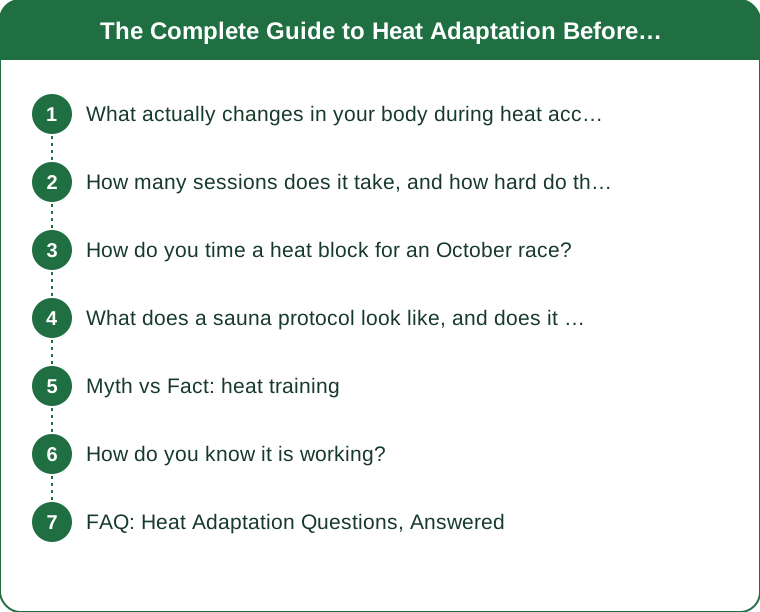
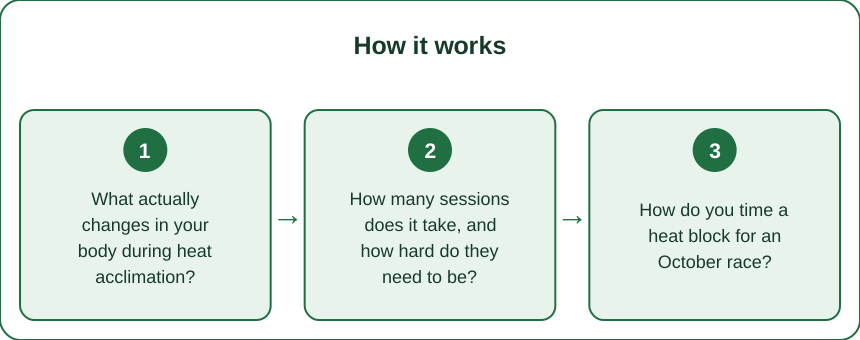
What actually changes in your body during heat acclimation?
Four measurable adaptations, and they arrive on different timelines.
Plasma volume expansion, days 3 to 7. This is the fastest and arguably the most valuable change. The body retains additional fluid in the bloodstream, commonly increasing plasma volume by 3 to 5 percent and sometimes more. More plasma means greater stroke volume — more blood pumped per beat — which lowers heart rate at any given workload and improves the body’s ability to send blood both to working muscle and to the skin for cooling simultaneously. This is functionally similar to some of what altitude training aims at, and it happens in your own neighborhood in a week.
Earlier sweat onset, days 5 to 10. An acclimated body starts sweating at a lower core temperature and at a higher rate. You get wetter sooner, which sounds unpleasant and is actually the point: evaporative cooling begins before core temperature has climbed far, so the peak temperature you reach during any given effort is lower.
More dilute sweat, days 7 to 14. Sweat glands become more efficient at reabsorbing sodium, so you lose less salt per litre. This reduces the electrolyte deficit over long efforts and is why the white salt crust on your kit tends to diminish across a summer of consistent training.
Lower resting and exercising core temperature, throughout. Baseline core temperature drops slightly and the temperature you reach at any given intensity drops with it, which raises the ceiling before heat becomes the performance limiter.
One thing that does not change: your sweat rate goes up, not down, so your fluid requirement increases rather than decreasing. Acclimation makes you better at cooling, not less dependent on water. Getting this backwards is how well-adapted athletes still end up dehydrated.
How many sessions does it take, and how hard do they need to be?
Fewer than most people expect, and easier than most people assume.
The consensus timeline: meaningful adaptation begins around day 4 or 5, substantial adaptation lands at 10 to 14 days, and near-complete adaptation takes about two weeks of consistent exposure. Some studies show useful plasma volume changes within 5 days.
Consistency matters more than intensity. Daily or near-daily exposure drives adaptation faster than three hard sessions a week. The stimulus is elevated core temperature sustained over time, not maximal effort.
Session structure that works:
- Duration: 60 to 90 minutes of exposure per session, of which the exercise portion can be 30 to 60 minutes.
- Intensity: easy to moderate. This is deliberately not a hard session. You are stacking a heat stimulus on top of aerobic work, and stacking a hard effort on top of that is how people end up cooked rather than adapted.
- Frequency: 5 to 7 days a week during the acclimation block, then 2 to 3 times a week to maintain.
Where to do it: the simplest option is training outdoors at the hottest part of your day, which in late summer requires no equipment and no plan. Alternatives include overdressing in mild conditions, indoor training without a fan, or a post-workout sauna, which produces real plasma volume adaptation and is considerably more tolerable than a hard run in 90-degree humidity.
The most common structural error: trying to do quality speed work during the heat block. Keep intervals and threshold sessions in cool conditions — early morning, air conditioning, or a treadmill — and do the heat work on easy days. You want both stimuli, delivered separately.
How do you time a heat block for an October race?
Work backwards from the race and respect the decay curve.
The decay timeline: adaptations begin fading within a few days of stopping exposure. Plasma volume gains decline noticeably in the first week, and most of the acclimation is gone by three to four weeks without exposure. Some of the sweat-gland adaptations persist a little longer.
A workable calendar for an early-to-mid October race:
- Late August into early September: the main acclimation block. 10 to 14 consecutive days of deliberate heat exposure on easy sessions.
- Mid September: maintenance. Two to three heat sessions per week — one hot easy run and one or two sauna sessions is plenty. Quality work moves fully to cool conditions.
- Final 10 days: stop deliberate heat work. Taper week is not the time to add thermal stress, and the adaptations you built will still be substantially present on race day.
What you actually get on a cool race day: the plasma volume expansion improves cardiovascular efficiency regardless of temperature. Studies on heat acclimation followed by cool-condition performance have repeatedly found small but real improvements — commonly in the range of a few percent — which at half-marathon distance is minutes rather than seconds.
And the more likely scenario worth preparing for: an unseasonably warm October race day. Fall races are notorious for it. An acclimated runner on an unexpectedly warm morning is dramatically better positioned than one who trained exclusively at 5am to avoid the heat, and that insurance alone justifies the block.

What does a sauna protocol look like, and does it actually work?
It works, it is easier to control than weather, and the protocol is specific.
The evidence: post-exercise sauna use has been shown to increase plasma volume and improve endurance performance in trained runners, with one frequently cited study using 30-minute sessions after training over three weeks and finding meaningful improvements in run time to exhaustion. Sauna acclimation triggers many of the same adaptations as exercising in heat.
A practical starting protocol:
- Timing: immediately after your easy run or ride, while core temperature is already elevated. This shortens the time needed to reach the adaptive stimulus.
- Temperature: a conventional dry sauna at roughly 175 to 195°F, or a steam room, which feels hotter at a lower temperature because evaporation is blocked.
- Duration: start at 10 to 15 minutes and build toward 20 to 30 across two weeks. Do not start at 30.
- Frequency: 3 to 4 sessions a week during a block.
- Hydration: weigh yourself before and after. Replace roughly 125 to 150 percent of the weight lost, with sodium included, over the following few hours.
Infrared saunas operate at lower air temperatures and heat tissue more directly. They are more comfortable and there is less research on them for athletic acclimation specifically. They are not a bad option, they are a less-studied one.
Who should be cautious or avoid it: anyone pregnant, anyone with cardiovascular conditions, low blood pressure, or on medications affecting heat regulation or fluid balance. Alcohol and sauna is a genuinely dangerous combination. Talk to a clinician before starting a sauna protocol if any of that applies. This is general information, not medical advice.
The honest comparison: a hot easy run and a post-run sauna produce broadly similar adaptations. The sauna is more controllable, more comfortable, and does not require you to run in dangerous conditions. If you have access, it is the better tool.
Myth vs Fact: heat training
Myth: If you train in heat all summer, you are automatically acclimated.
Fact: Only if the exposure was consistent and sustained. Running at 6am to avoid the heat all summer produces very little adaptation, and that describes most people’s summer training. Adaptation requires actually being hot for a sustained period, repeatedly.
Myth: Heat adaptation means you need less water.
Fact: The opposite. Acclimated athletes sweat more, sooner, and therefore need more fluid, not less. The efficiency gain is in cooling, not in conservation.
Myth: Suffering more means adapting more.
Fact: The stimulus is sustained elevated core temperature, not maximal distress. Pushing into genuine heat illness territory produces damage and days of lost training, not faster adaptation. If you stop sweating, get chills, feel confused or nauseated, or your skin goes cold and clammy, stop immediately and cool down — those are warning signs of heat illness and they are a medical matter, not a toughness matter.
Myth: Heat and cold exposure cancel each other out.
Fact: They are different stimuli with different mechanisms, but timing matters. A cold plunge immediately after a heat session may blunt some of the acute thermal signal driving adaptation. During an acclimation block, leave a gap of a few hours, or save cold exposure for days you are not chasing heat adaptation.
Myth: You lose it all in a few days.
Fact: Decay is gradual. The first week after stopping costs you relatively little, which is exactly why a 10-day taper without heat work does not undo the block.
How do you know it is working?
Four signals, all of which you can track without laboratory access.
1. Heart rate at a fixed easy pace drops. This is the clearest marker. Pick one route and one pace, run it at roughly the same time of day and in similar conditions once a week, and watch average heart rate. A drop of 5 to 10 beats over two weeks with no change in fitness is the plasma volume adaptation showing up.
2. You start sweating earlier. Note roughly how many minutes into an easy run you begin sweating visibly. Acclimation moves this earlier, often noticeably so within the first week to ten days.
3. Less salt residue. Dark kit that used to dry with white crusting shows less of it as sweat sodium concentration falls.
4. Perceived effort in heat drops. The subjective one, and the one athletes notice first. A run that felt brutal in week one feels merely warm in week two at the same conditions and pace.
What to log: date, conditions if you can get them, route, average pace, average heart rate, and a one-to-ten rating of how hot it felt. Four data points a week for two weeks gives you a clear picture, and it takes 30 seconds per session.
A caution about reading the data: heart rate at a given pace also drops with general aerobic fitness, so some of the improvement over a two-week block is ordinary training effect. That does not matter much practically — both are adaptations you wanted — but it does mean you should not attribute all of it to the heat.
FAQ: Heat Adaptation Questions, Answered
Can I acclimate on a treadmill in an air-conditioned gym?
Not without effort. You would need to raise your own thermal load — extra layers, no fan, a warmer room. The stimulus is core temperature, so if you are comfortable, nothing is adapting.
Does heat training help with altitude?
There is genuine overlap, since both involve plasma volume and cardiovascular adjustments, and some research suggests heat acclimation confers partial benefit at altitude. It is not a full substitute, but it is a legitimate secondary benefit.
I am doing hot yoga three times a week. Does that count?
Partly. It provides heat exposure and does contribute to plasma volume adaptation. It provides less cardiovascular stimulus than hot aerobic training, so it is a supplement to a running block rather than a replacement for one.
What about hydration during the block specifically?
Increase fluid intake alongside the exposure, include sodium — roughly 300 to 600mg per litre is a common range for heavy sweaters — and use morning body weight as your simplest check. A drop of more than 2 percent from your normal baseline means you started the day under-hydrated.
Should I do this if my race is in November or December?
Probably not as a dedicated block. The decay curve means an August block does very little for a December race. In that case, train through the summer heat sensibly and put your structured work into the training itself.
TL;DR:
- 10 to 14 days of consistent heat exposure raises plasma volume 3 to 5 percent, lowers heart rate at any pace, and starts sweating earlier and less salty.
- Keep heat sessions easy — 60 to 90 minutes of exposure, 5 to 7 days a week during the block, quality work in cool conditions.
- For an October race: block in late August, maintain in mid-September, stop deliberate heat work in the final 10 days.
- Post-run sauna at 175 to 195°F for 20 to 30 minutes, 3 to 4 times a week, produces similar adaptations more controllably.
- Track heart rate on one fixed easy route weekly — a 5 to 10 beat drop is the adaptation showing up.
- Acclimation increases fluid needs rather than reducing them, and heat illness signs mean stop, not push.
August training is going to be hot either way. Structuring it turns two uncomfortable weeks into a measurable advantage on a cool October morning.
Keep Reading
This article is for general informational purposes only and is not medical advice. Always consult a qualified health professional for guidance specific to you.