The Complete Guide to Fitting Heat and Cold Therapy Into a 9 to 5
Quick Answer: The two rules that survive a real schedule are: keep cold away from the 4 hours after strength training, and keep heat away from the 90 minutes before bed. Everything else is negotiable. If you only have a morning window, use cold and treat it as an alertness tool. If you only have an evening window, use heat and finish at least 90 minutes before lights out. If you have a lunch break, that is the single best slot for contrast work, because nothing important is competing for it.
Every protocol you read was written by someone with an open Tuesday.
Two rounds of 15 minutes in the sauna, three minutes in the plunge, twenty minutes of quiet rest between. Wonderful. You have a 40-minute window between a meeting and a school pickup, and the gym sauna shuts off at 8.
The good news is that the constraints are fewer and more forgiving than the protocols suggest. There are two genuine timing conflicts. Everything else is preference dressed up as science.

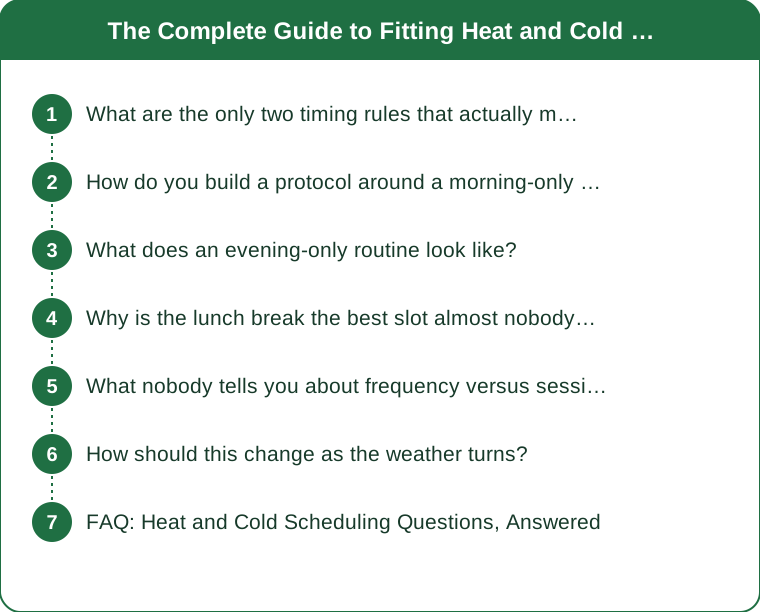
What are the only two timing rules that actually matter?
Strip away the protocol theater and two conflicts remain, both well supported.
Conflict one: cold water immersion blunts strength and hypertrophy adaptations if you use it too close to resistance training. The mechanism is real. Cold immersion suppresses the inflammatory and signaling cascade that tells muscle to rebuild bigger. Studies using cold immersion immediately after lifting show meaningfully reduced strength and muscle gains over 7 to 12 week blocks. The practical buffer is about 4 hours, and 6 is safer if your primary goal is building muscle.
Conflict two: heat raises core temperature, and falling core temperature is one of the strongest sleep-onset signals you have. A sauna 30 minutes before bed leaves you warm at exactly the moment your body wants to be shedding heat. Finish heat exposure at least 90 minutes before you want to be asleep and the rebound cooling actually helps you.
That is the whole list. Not a single one of the elaborate ordering debates has anything close to this level of evidence behind it.
Everything that follows is just fitting those two rules around a calendar you did not design.
How do you build a protocol around a morning-only window?
If the only reliable time you control is before work, cold is your tool and heat is a weekend thing.
Cold exposure in the morning does something heat cannot: it produces a sharp, sustained rise in norepinephrine that lasts a couple of hours. That is a genuine alertness effect, and it lands exactly when you want it.
A 12-minute morning version that fits before a shower:
- Two minutes of easy movement first. Arm circles, a few squats, anything that gets you out of a cold start. Going straight from bed into cold water makes the gasp reflex worse.
- Cold shower or plunge, 2 to 3 minutes, cold enough to be uncomfortable but not so cold you cannot control your breathing. Around 12 to 15 degrees Celsius is plenty for a plunge; a cold tap shower is usually 15 to 18.
- Slow nasal breathing throughout. The breath control is most of the benefit. If you are gasping, it is too cold or too fast an entry.
- Air dry or towel briefly. Do not immediately jump into a hot shower, which cancels the vascular effect you just paid for.
The scheduling catch: if you lift in the morning, this order is backwards. Cold before lifting is fine, cold after is the conflict. Do the cold first, then train, and you have solved it. If you lift in the evening, morning cold is completely uncomplicated.
Skip morning heat unless you have a full hour. A rushed sauna leaves you sweating through your first meeting, and the parasympathetic rebound from heat is mildly sedating, which is not what a Monday morning needs.
What does an evening-only routine look like?
Evening belongs to heat, and the reason is the same mechanism that makes evening heat risky if you time it badly.
After a sauna, your core temperature rises, then overshoots downward during the cooling phase. That downward slope is a powerful sleep signal. Time it right and you fall asleep faster than usual. Time it wrong and you lie there radiating.
The 90-minute rule is the whole game. Sauna finishing at 8:00 for a 10:00 bedtime works beautifully. Sauna finishing at 9:30 for the same bedtime works against you.
A 30-minute evening version:
- 15 to 20 minutes of heat, whether that is a sauna at 80 to 90 degrees Celsius, a steam room, or a genuinely hot bath at around 40 degrees. A hot bath is underrated here and available to almost everyone.
- A brief cool rinse at the end, 30 to 60 seconds. This is not a plunge. It is just accelerating the cooling curve so you are not still warm at bedtime.
- Rehydrate with something containing sodium. You lost more than water.
- Keep the room cool afterward. Undoing the cooling curve with a warm bedroom wastes the whole thing.
If you lifted that evening, the cool rinse is fine. It is short and mild and does not reach the tissue temperatures that blunt adaptation. A three-minute plunge would be a different story.

Why is the lunch break the best slot almost nobody uses?
Midday is the least contested hour in most schedules and the most flexible one physiologically.
Nothing important conflicts with it. You are usually 4 or more hours out from a morning lift and 4 or more hours out from an evening one. You are nowhere near bedtime, so heat costs you nothing. And the mild afternoon alertness bump from cold exposure arrives right when most people slump.
A 35-minute contrast session that fits a lunch hour:
- 12 minutes heat
- 2 minutes cold
- 5 minutes ambient rest
- 10 minutes heat
- 2 minutes cold
- Finish on cold, dress, eat at your desk
On the finish-hot-versus-finish-cold argument: finish cold if you want alertness afterward, finish hot if you want to feel settled. The evidence for one being categorically better than the other is thin. The evidence for what you personally want to feel like at 2pm is sitting right there in your own experience.
The practical obstacle is not physiological, it is logistical: hair, a second shower, and getting back on time. Which is exactly why so few people do it, and why the sauna is empty at noon.
What nobody tells you about frequency versus session length
Everyone optimizes the session. Almost nobody optimizes the count, and the count is what the evidence actually supports.
The strongest observational data on sauna use, the long-running Finnish cohort work, found the clearest associations at 4 or more sessions per week. The session length in that data was modest, often around 15 minutes. It was the frequency that tracked with outcomes, not heroic single sessions.
Cold shows a similar pattern. The adaptation to cold exposure, the part where the gasp response settles and you can actually breathe through it, is built by repetition. Ten 2-minute exposures across two weeks does more than two 10-minute exposures.
The reframe for a busy schedule: stop asking how to fit a proper 60-minute protocol into your week. Ask how to fit 15 minutes into four days.
- Four 15-minute sauna sessions beats one 60-minute session, and it is easier to schedule.
- A 2-minute cold shower at the end of your normal shower costs you almost nothing and counts.
- Consistency at low doses beats perfection at high ones, and this is one of the few areas where that cliche is genuinely supported.
The corollary: a session you skip because you could not do the full protocol is worth zero. A shortened one is worth most of it.
How should this change as the weather turns?
Late summer into fall is when most people’s heat and cold habits quietly break, and it is worth planning around.
Cold gets harder and more valuable at the same time. An outdoor plunge or a cold shower in August is refreshing. The same water in October feels like a different substance, because your starting skin temperature is lower and the contrast is larger. Expect to need a slightly warmer setting for the same subjective difficulty, and expect your tolerance to genuinely improve over the season if you stay consistent.
Heat gets easier and more appealing. Sauna attendance climbs every fall for a reason. Use that. If you have been meaning to build a four-times-weekly habit, the season is about to do half the motivational work for you.
The transition trap: people who used cold all summer for cooling rather than for adaptation tend to drop it entirely once the weather changes, because the original reason disappeared. If you want the alertness and mood effects, that reason did not disappear. Decide now which one you were actually after.
One seasonal adjustment worth making: move heat later in the day as evenings get darker and colder. The sleep-onset benefit is more useful in fall and winter than it was in July, when you were probably fighting to cool down anyway.
FAQ: Heat and Cold Scheduling Questions, Answered
Can I do cold plunge and sauna on the same day I lift?
Yes, with a buffer. Keep cold immersion at least 4 hours away from resistance training if muscle growth is the goal. Sauna has no such conflict and can go right after.
Is a hot bath as good as a sauna?
For the cardiovascular and sleep-related effects, a 40-degree bath for 15 to 20 minutes gets you a large share of the benefit. It heats you more efficiently than dry sauna at a lower air temperature because water conducts heat far better than air.
How many times a week is actually worth it?
Aim for 3 to 4 short sessions rather than 1 long one. Frequency is what the strongest observational data tracks with, and short sessions are what actually survive a real schedule.
This is general information, not medical advice. If you are pregnant, have cardiovascular conditions, or take blood pressure medication, talk to your doctor before starting heat or cold protocols.
TL;DR:
- Only two timing rules are well supported: keep cold immersion 4 or more hours from lifting, and finish heat 90 or more minutes before bed.
- Morning window: use cold, 2 to 3 minutes, before you train rather than after.
- Evening window: use heat, finish by the 90-minute mark, cool rinse at the end.
- Lunch break is the least contested and most flexible slot, and almost nobody uses it.
- Frequency beats duration. Four 15-minute sessions outperform one 60-minute one, and they actually fit.
The protocol that works is the one that survives a Tuesday with two meetings and a late train. Build for that week, not the ideal one.
Keep Reading
This article is for general informational purposes only and is not medical advice. Always consult a qualified health professional for guidance specific to you.