The Complete Guide to Contrast Therapy for Recovery
Quick Answer: Contrast therapy — alternating heat (sauna, hot bath) with cold (cold plunge, cold shower) — works by cycling blood vessels between dilation and constriction, which can support circulation and perceived recovery, though the science on performance benefits specifically is more mixed than the wellness marketing suggests.
The sauna-to-cold-plunge routine has gone from niche recovery tool to something you see lines forming for at every gym with a wellness area. Here’s what’s actually happening in your body when you do it, and how to do it well.

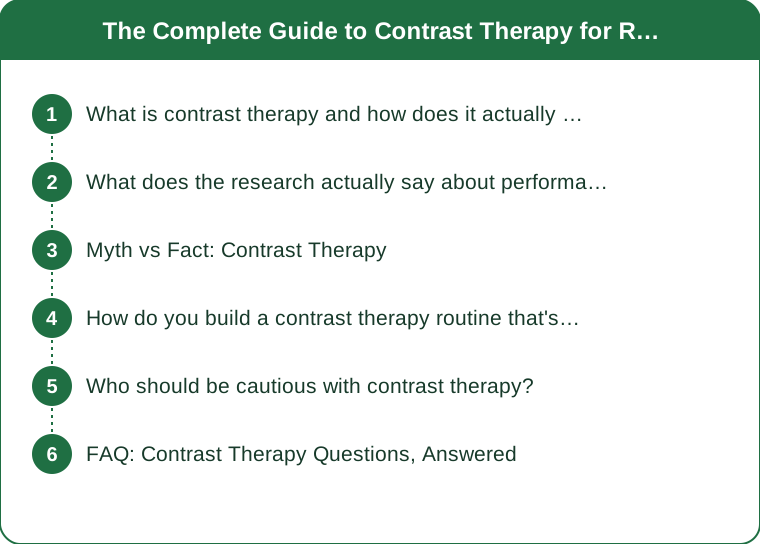
What is contrast therapy and how does it actually work?
Contrast therapy alternates heat exposure (raising blood vessel dilation and blood flow) with cold exposure (triggering vasoconstriction), and the repeated switching is thought to create a pumping effect that may support circulation and waste product clearance in muscle tissue.
The heat phase also relaxes muscle tissue and can reduce perceived stiffness, while the cold phase is associated with reduced inflammation markers in some research, though effect sizes vary considerably between studies and individuals.
Most formal protocols alternate in cycles of roughly 3-5 minutes of heat followed by 30 seconds to 2 minutes of cold, repeated 2-4 times, always ending on cold for a recovery-focused session.
What does the research actually say about performance and recovery benefits?
The evidence is genuinely mixed and worth understanding honestly — some studies show contrast therapy modestly reduces perceived muscle soreness (DOMS) after intense exercise, while others find no significant difference compared to passive rest.
Where the research is more consistently positive is subjective recovery and readiness to train again — many athletes report feeling recovered faster even when objective muscle damage markers show similar timelines to rest alone. This subjective effect is real and worth valuing, even if it’s partly about how the routine primes your mind and nervous system, not purely mechanical repair.
What’s clearer: cold exposure immediately after heavy strength training may blunt some hypertrophy (muscle growth) signaling in the following hours, so timing matters if muscle growth is a primary goal, not just recovery.
Myth vs Fact: Contrast Therapy
Myth: More extreme temperatures and longer sessions produce better results. Fact: research generally supports moderate, consistent protocols over extreme one-off sessions — a 40°F cold plunge for 2 minutes isn’t meaningfully better than 50°F for the same duration for most recovery goals.
Myth: Contrast therapy detoxes your body. Fact: there’s no meaningful evidence that heat or cold exposure removes toxins — the real mechanisms are circulation, inflammation modulation, and nervous system effects, not detoxification.
Myth: You need a dedicated cold plunge tub to get benefits. Fact: a cold shower for 1-2 minutes after a warm bath or sauna session activates largely the same physiological response as an expensive plunge tub setup.

How do you build a contrast therapy routine that’s actually sustainable?
Start with shorter, more moderate sessions — 2-3 minutes of heat, 30-60 seconds of cold, repeated twice — rather than jumping straight into extended sauna and ice-bath protocols seen on social media, which can be genuinely uncomfortable and unsustainable long-term.
Consistency matters more than intensity — a moderate routine done 2-3 times a week for months shows more benefit than an occasional extreme session. Build the habit before extending duration or lowering the cold temperature further.
Hydration is also frequently overlooked: both heat and cold exposure are dehydrating, so drinking water before and after sessions supports how well your body actually handles the temperature swings.
Who should be cautious with contrast therapy?
People with cardiovascular conditions, uncontrolled blood pressure, or a history of fainting should consult a doctor before starting, since rapid temperature shifts genuinely stress the cardiovascular system through repeated vessel constriction and dilation.
Pregnant individuals and people with Raynaud’s syndrome or certain skin conditions are also generally advised to avoid extreme cold exposure specifically. This is general information, not medical advice — check with a healthcare provider if you have any underlying condition before starting a new hot-cold routine.
FAQ: Contrast Therapy Questions, Answered
How soon after a workout should I do contrast therapy?
Most protocols suggest waiting at least an hour after strength training if muscle growth is a priority, since immediate cold exposure may blunt some growth signaling — for general recovery or soreness relief, timing is more flexible.
Is cold water immersion alone (without heat) just as effective?
Cold alone does provide some of the inflammation and soreness benefits, but the alternating cycle with heat is what’s thought to create the additional circulation “pumping” effect that cold alone doesn’t replicate.
How many times a week should I do this?
2-3 times weekly is a commonly recommended starting frequency for general recovery goals — daily use is common among dedicated practitioners but isn’t necessary to see meaningful benefit.
TL;DR:
- Contrast therapy alternates heat and cold to cycle blood vessel dilation and constriction
- Research on performance benefits is mixed, but subjective recovery benefits are consistently reported
- Cold right after strength training may blunt some muscle growth signaling — timing matters
- Moderate, consistent sessions (2-3x weekly) beat occasional extreme ones
- People with cardiovascular conditions should check with a doctor before starting
Start small — a warm shower followed by 30 seconds of cold is a legitimate entry point, not a compromise.
Keep Reading
This article is for general informational purposes only and is not medical advice. Always consult a qualified health professional for guidance specific to you.