The Complete Guide to Cold and Heat Exposure When You Are Run Down or Getting Sick
Quick Answer: Skip cold exposure entirely if you have a fever, chills, body aches, or symptoms below the neck. Cold is a sympathetic stressor and your body is already running one. For mild above-the-neck symptoms - a blocked nose, a mild sore throat, no fever - a short warm sauna is generally better tolerated than cold, and cold is best reduced or paused. Return gradually: half your usual duration, warmer temperature, and only once you have had two normal nights of sleep.
The protocol has been working for months. Then you wake up run down and the question is whether to keep the streak.
The honest answer depends entirely on where your symptoms are and whether you have a fever - and one of those answers is not a judgement call.
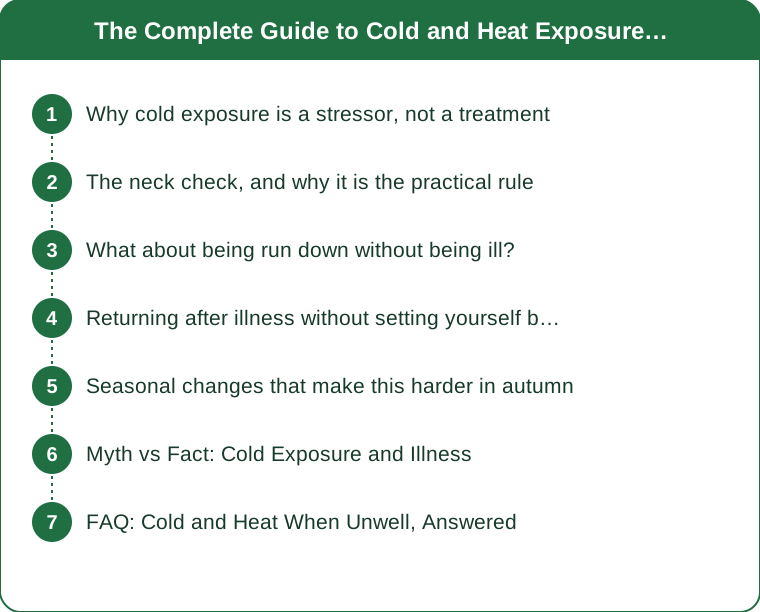
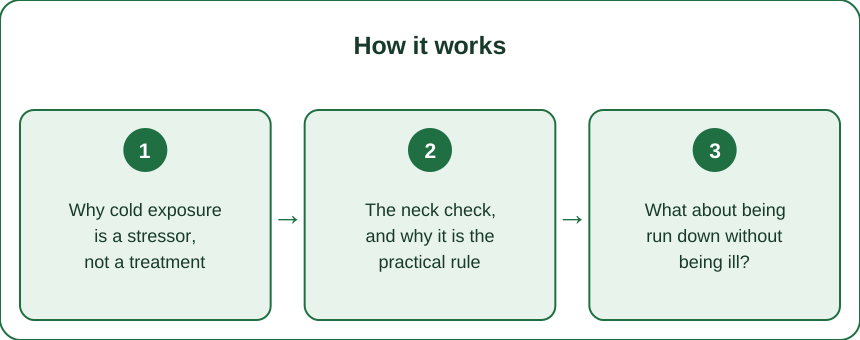
Why cold exposure is a stressor, not a treatment
Cold water immersion triggers a large sympathetic response. Heart rate, blood pressure, and stress hormones all rise sharply, and that response is precisely what makes cold exposure a training stimulus rather than a passive comfort.
Your body has a finite capacity to absorb stressors, and it does not distinguish neatly between sources. Training load, poor sleep, work stress, and an immune response all draw on overlapping resources.
When you are healthy and rested, that stressor produces adaptation. The response resolves, you recover, and the next exposure is slightly easier. This is the whole mechanism and it depends on having capacity to spare.
When you are already depleted, the same stressor adds to a load that is not clearing. You get the cost without the adaptation, which is the difference between a protocol that helps and one that quietly digs a hole.
The cold shock response also has an immediate cardiovascular cost. The gasp reflex, the rise in blood pressure, and the sharp increase in cardiac demand are meaningful, and they are worse when you are dehydrated or feverish - both common when you are getting ill.
Sleep is where most of the recovery from both illness and cold exposure happens, which is why doing cold exposure late in the evening while unwell tends to compound the problem. The sympathetic activation can delay sleep onset by exactly the hour you most need.
And the psychological framing works against you here. Cold exposure attracts people who value discipline, and discipline is a poor guide to whether a stressor is affordable on a given day. The protocol does not know you are ill; you have to.
The neck check, and why it is the practical rule
The common guideline for exercise applies reasonably well here: symptoms above the neck - a runny or blocked nose, mild sore throat, sneezing, no fever - are generally compatible with gentle activity. Symptoms below the neck are not.
Below-the-neck symptoms mean stop. Chest congestion, a productive cough, body aches, stomach upset, or any fever means no cold exposure and no sauna at meaningful intensity. This is not a cautious recommendation - it is the clear line.
Fever is an absolute contraindication for cold immersion. Your thermoregulation is already disrupted, your cardiovascular system is under load, and adding a cold shock response to that is genuinely risky rather than merely unhelpful.
Fever is also a contraindication for sauna, for the same reason in the opposite direction. Heating a body that is already running a raised core temperature adds strain and dehydration to an existing fluid deficit.
Above-the-neck-only symptoms give you a real choice, and the choice is usually to reduce rather than to continue as normal. A shorter, warmer exposure gives you routine and warmth without the full stressor.
Dehydration is the variable that quietly decides the outcome. Illness raises fluid losses through fever, sweating, and reduced intake, and both sauna and cold exposure add to that. If you have not been drinking normally, neither is a good idea regardless of where your symptoms are.
And the neck check is a floor rather than a ceiling. Feeling genuinely unwell without a clear symptom to point at is sufficient reason to skip. This is general information, not medical advice - if symptoms are severe, persistent, or you have any cardiac or respiratory condition, ask a clinician rather than a rule of thumb.
What about being run down without being ill?
This is the more common situation and the more nuanced one. Poor sleep, a heavy training block, travel, or a stressful week all reduce your capacity without producing a symptom you can name.
Heart rate variability and resting heart rate are the useful markers here, if you track them. A resting heart rate several beats above your normal, or a clearly depressed variability reading, suggests your system is already working - and adding a stressor on top has a poor return.
Reduce duration first, then temperature. Halving your usual time in cold water preserves the routine and the psychological benefit while cutting the physiological cost substantially.
Warm exposure is usually the better choice when run down but not ill. A moderate sauna session promotes parasympathetic activity afterwards, which is the direction you want when depleted - whereas cold pushes the other way in the short term.
Move the session earlier in the day. Cold exposure within a few hours of bed can delay sleep onset, and sleep is the resource you are short of. Morning or early afternoon is a meaningful improvement over evening.
Skip contrast protocols entirely on low days. Alternating hot and cold is the most demanding format, and it is the first thing to cut when capacity is limited.
And treat two consecutive poor nights as a hard signal. One bad night is noise; two is a pattern, and continuing a full cold protocol through it is the most common way people turn being tired into being ill.
Returning after illness without setting yourself back
Wait until you have had two normal nights of sleep and a full day without symptoms before resuming any cold exposure. Feeling better in the afternoon is not the same as being recovered.
Start at roughly half your previous duration. If you were doing three minutes, do ninety seconds. The adaptation you built is not gone, and rebuilding tolerance takes far less time than building it did.
Warm the water or shorten the exposure, not both at once, so you can tell what you are tolerating. Changing one variable makes the next decision easier.
Rebuild over three to four sessions rather than one. Most people are back to their previous protocol inside two weeks, and pushing to get there in one session is the reliable way to relapse.
Expect the cold to feel harder than it did. Cold tolerance is partly a learned response and it fades quickly with a break. Feeling shocked by water you handled easily a fortnight ago is normal and temporary.
Watch your recovery between sessions rather than within them. If you feel flat the day after resuming, that is the signal to hold at the current level for another session or two.
And if you were on antibiotics or had a significant illness, ask your doctor before resuming cold immersion specifically. The cardiovascular demand of cold shock is not trivial, and post-illness is exactly when individual advice beats a general protocol.
Seasonal changes that make this harder in autumn
Outdoor water temperature drops fast in early autumn. A tub or lake that was a comfortable fourteen degrees in August can be several degrees colder within weeks, which means your usual duration is now a considerably larger dose.
Recalibrate by time, not by habit. If you have been doing three minutes all summer without checking the temperature, the same three minutes in October is a different exposure entirely. Measure the water.
Cold air after cold water is the underrated risk. Getting out into fifteen degrees is very different from getting out into thirty, and rewarming takes considerably longer. Have dry layers ready before you get in, not after.
This is also the season when illness circulates more, which means the neck check comes up more often. Having decided your rule in advance makes the decision easier when you are tired and want to keep the streak.
Sauna use rises naturally in autumn and that is a reasonable shift. Heat exposure suits the season and tends to be better tolerated when you are run down than cold does.
Rewarming actively matters more now. Move, put on layers, have a warm drink - passive rewarming in a cold room extends the stressor well past the exposure itself, and that tail is where a lot of the fatigue comes from.
And shorter days affect sleep timing, which affects capacity, which affects how much cold you can afford. The variables move together in autumn, which is why a protocol that ran smoothly all summer needs a review rather than a repeat.
Myth vs Fact: Cold Exposure and Illness
Myth: Cold exposure boosts immunity, so it helps when you are getting sick. Fact: regular cold exposure in healthy people is associated with some immune markers changing, but an acute exposure while ill is a stressor added to an existing one. The evidence for training an immune system is not evidence for using it as treatment.
Myth: You can sweat out a cold in the sauna. Fact: you cannot. You can dehydrate yourself while raising cardiovascular strain, and dehydration usually makes symptoms feel worse rather than better.
Myth: A mild fever is fine if you feel up to it. Fact: fever is a clear contraindication for both cold immersion and sauna. Thermoregulation is already disrupted and the cardiovascular demand is real.
Myth: Breaking the streak sets you back significantly. Fact: cold tolerance rebuilds far faster than it built. A week off costs you a couple of sessions of adjustment, not months of adaptation.
Myth: Cold exposure is safe if you feel fine during it. Fact: the cost often appears as poor sleep that night and flatness the next day. Judge the session by the following twenty-four hours, not by how you felt in the water.
Myth: If in doubt, a shorter plunge is always safe. Fact: for above-the-neck symptoms, shorter is a reasonable adjustment. With fever or below-the-neck symptoms, shorter is not the answer - skipping is.
FAQ: Cold and Heat When Unwell, Answered
Can I cold plunge with a cold?
With mild above-the-neck symptoms and no fever, a shortened, warmer exposure is generally tolerated. With fever, body aches, chest symptoms, or stomach upset, skip it entirely.
Is the sauna better than cold when I am run down?
Usually, yes - if there is no fever. Heat exposure promotes parasympathetic activity afterwards, which suits a depleted system better than the sympathetic push of cold.
How long should I wait after being ill?
Two normal nights of sleep and a full symptom-free day, then resume at about half your previous duration and rebuild over three or four sessions.
Will I lose my cold adaptation if I stop for a week?
Some tolerance fades quickly, but it rebuilds much faster than it built. Expect the first session back to feel harder than it should and expect that to resolve within a couple of sessions.
What if I am not ill, just exhausted?
Halve the duration, move the session earlier in the day, skip contrast protocols, and consider heat instead of cold. Two consecutive poor nights is a strong signal to reduce.
Does the cooling autumn water change anything?
Significantly. The same duration in colder water is a larger dose, and cold air afterwards extends the stressor. Measure the water and have dry layers ready before you get in.
When should I ask a doctor?
Before resuming cold immersion after a significant illness, if you have any cardiac or respiratory condition, or if symptoms are severe or persistent. This article is general information, not medical advice.
TL;DR:
- Cold exposure is a sympathetic stressor - it helps when you have capacity to spare and costs you when you do not.
- Fever, body aches, chest symptoms, or stomach upset mean skip both cold and sauna entirely.
- Mild above-the-neck symptoms allow a shortened, warmer session; heat is usually better tolerated than cold when run down.
- Return after illness at half duration, rebuilt over three or four sessions, once you have had two normal nights of sleep.
- Autumn water is colder than your habit assumes - measure it, and have dry layers ready before you get in.
Judge a session by the following twenty-four hours, not by how you felt in the water.
Keep Reading
This article is for general informational purposes only and is not medical advice. Always consult a qualified health professional for guidance specific to you.