Cold Therapy When You Are Always Cold: The Complete Guide
Quick Answer: If you are the person who wears a cardigan indoors in August, standard cold plunge advice will not work for you and may actively backfire. You genuinely lose heat faster - less insulating tissue, a stronger vasoconstriction response, and often a lower resting metabolic output all mean you cool faster and rewarm slower. The fix is not toughing it out. It is shorter exposures (60 to 90 seconds, not 3 minutes), warmer water (12 to 15C rather than 4C), passive rewarming afterwards, and always ending your contrast sessions on heat.
The people who write plunge protocols run warm. Their three minutes at 4C is not your three minutes at 4C - and pretending otherwise is how cold-intolerant people end up shivering for two hours and giving up on the whole thing.
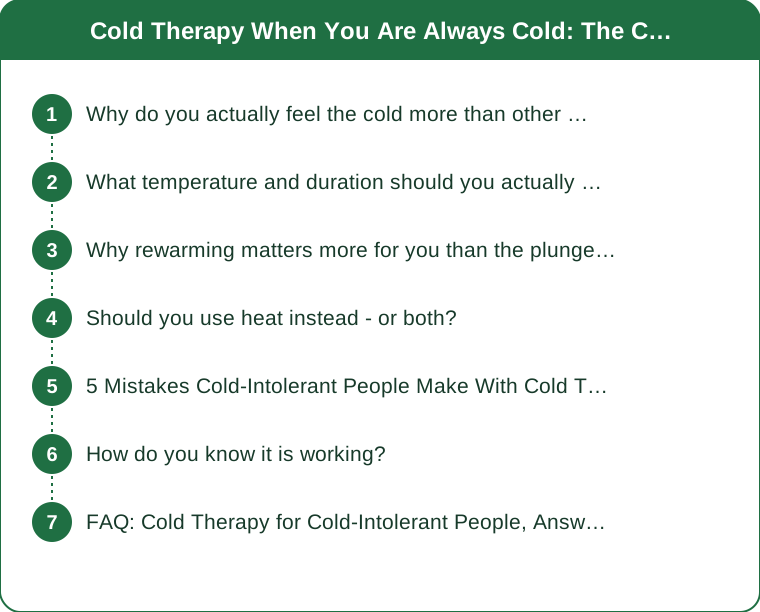
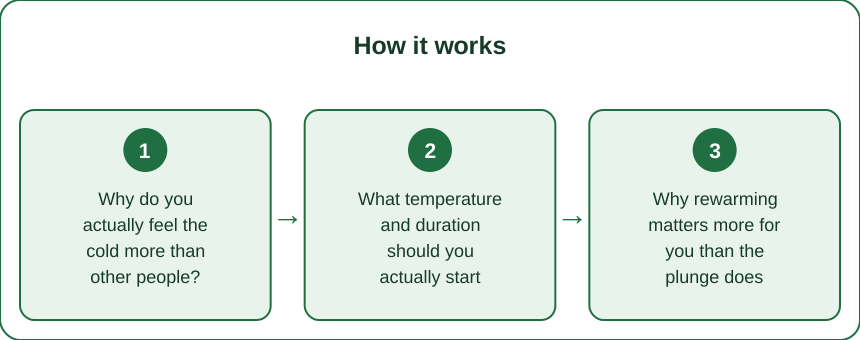
Why do you actually feel the cold more than other people?
This is not a mindset problem, and being told it is one is the fastest way to make somebody quit.
Surface area to mass ratio. Smaller and leaner bodies have more skin per kilogram of tissue. Heat leaves through skin. A smaller person can lose body heat meaningfully faster than a larger one in identical water, purely as geometry - before any question of toughness enters the picture.
Insulation. Subcutaneous fat is genuinely the body’s insulation layer, and people with less of it conduct heat out faster. This is why very lean endurance athletes are often the first ones shivering in an ice bath, despite being extremely fit. Fitness and cold tolerance are different variables.
Vasoconstriction sensitivity. In cold air or water, small vessels in the hands and feet clamp down to protect core temperature. In some people this response is unusually strong or unusually quick, so fingers and toes go white, numb, and painful long before the core is actually threatened. If your fingers turn white then blue then red on rewarming, that pattern is worth showing a doctor - it has a name and it changes how you should approach cold. This is general information, not medical advice.
Metabolic output. Your resting heat production varies with muscle mass, thyroid function, iron status, sleep, and how much you have eaten. Chronically under-eating is one of the most common and most overlooked causes of feeling cold all the time. So is low iron, particularly in women who train. If your cold intolerance is new rather than lifelong, that is a signal, not a personality trait.
The practical upshot: your cold dose is not the same as somebody else’s cold dose. The water temperature is identical; the physiological load is not.
What temperature and duration should you actually start at?
Forget the numbers you have seen on social media. They are optimised for content, not for you.
Start at 12 to 15C, not 4C. This range still produces the vasoconstriction, the noradrenaline response, and the mood effect that make cold exposure worth doing, at a fraction of the thermal cost. A cool bath topped with a single bag of ice usually lands right in this window. Most home cold tubs will hold it without any chilling equipment at all in autumn.
Start at 60 to 90 seconds, not 3 minutes. The bulk of the acute response happens in the first minute. The second and third minutes mostly add heat debt - which is precisely the thing you cannot afford. A cold-intolerant person often gets more total benefit from 90 seconds twice a week than from one heroic three minute session that leaves them shivering until lunchtime.
Progress by frequency before duration. The usual progression is to add time. Yours should be to add sessions. Move from once to twice to three times weekly at the same short duration, and only then extend to two minutes.
The honest stop signals:
- Shivering that starts while you are still in the water - get out now, that is your body losing the argument
- Fingers that go numb rather than just aching
- Any point where your breathing will not settle after 45 seconds
- Feeling cold for more than 30 to 40 minutes afterwards - that session was too much, shorten the next one
None of these are failures. They are dose information.
Why rewarming matters more for you than the plunge does
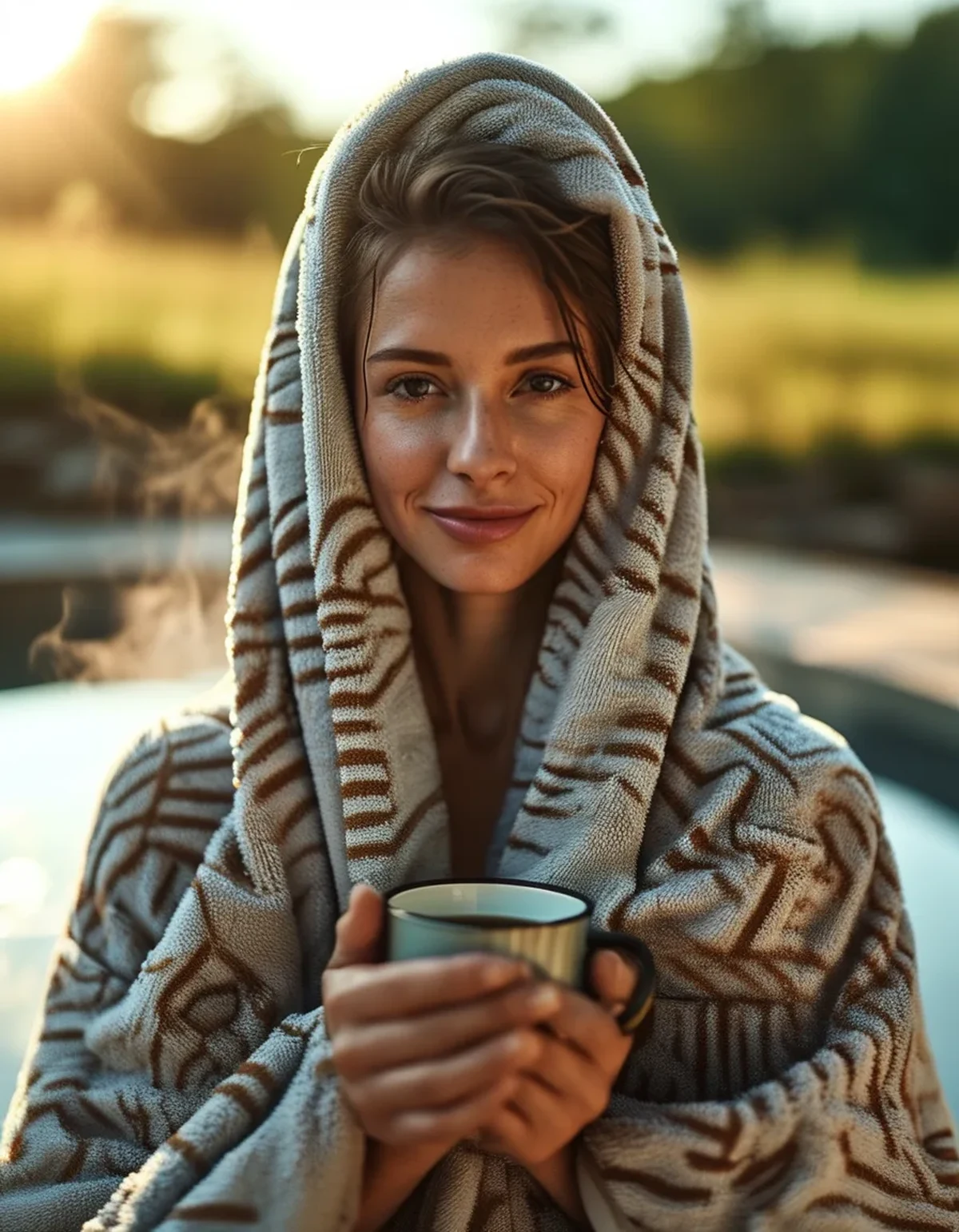
For someone who runs warm, rewarming happens by itself. For you, it is the actual technical skill of the whole practice, and getting it wrong is what ruins the rest of the day.
The afterdrop problem. When you get out, cold blood that has been sitting in your limbs starts circulating again as vessels reopen. Your core temperature can keep falling for 10 to 20 minutes after you leave the water. This is why people feel fine at the poolside and awful twenty minutes later. If you are already heat-poor, the afterdrop is deeper and lasts longer.
Passive rewarming beats aggressive rewarming. The instinct is a scalding shower. Resist it - hot water on cold skin reopens surface vessels fast, dumps more cold blood into your core, and can make you feel worse before better. Instead:
- Dry off completely and immediately - evaporating water off skin keeps cooling you long after you are out
- Layer up starting with the core, not the extremities: warm top first, then hands and feet
- Drink something hot. The internal heat contribution is small but the effect on comfort and on shivering is real
- Move gently - a slow walk or easy bodyweight movement produces heat metabolically without the shock of hot water
- Give it 20 minutes before deciding whether the dose was right
The debate about warming up too fast. For cold-intolerant people, this is largely a non-issue. The theoretical concern about blunting adaptation applies to people chasing maximum brown fat activation with regular exposure. Your limiting factor is not adaptation, it is heat budget - if you never rewarm properly you simply stop showing up. Warm up as fast as comfort requires.
Should you use heat instead - or both?
For a lot of cold-intolerant people, the honest answer is that heat is the better primary tool and cold is the seasoning.
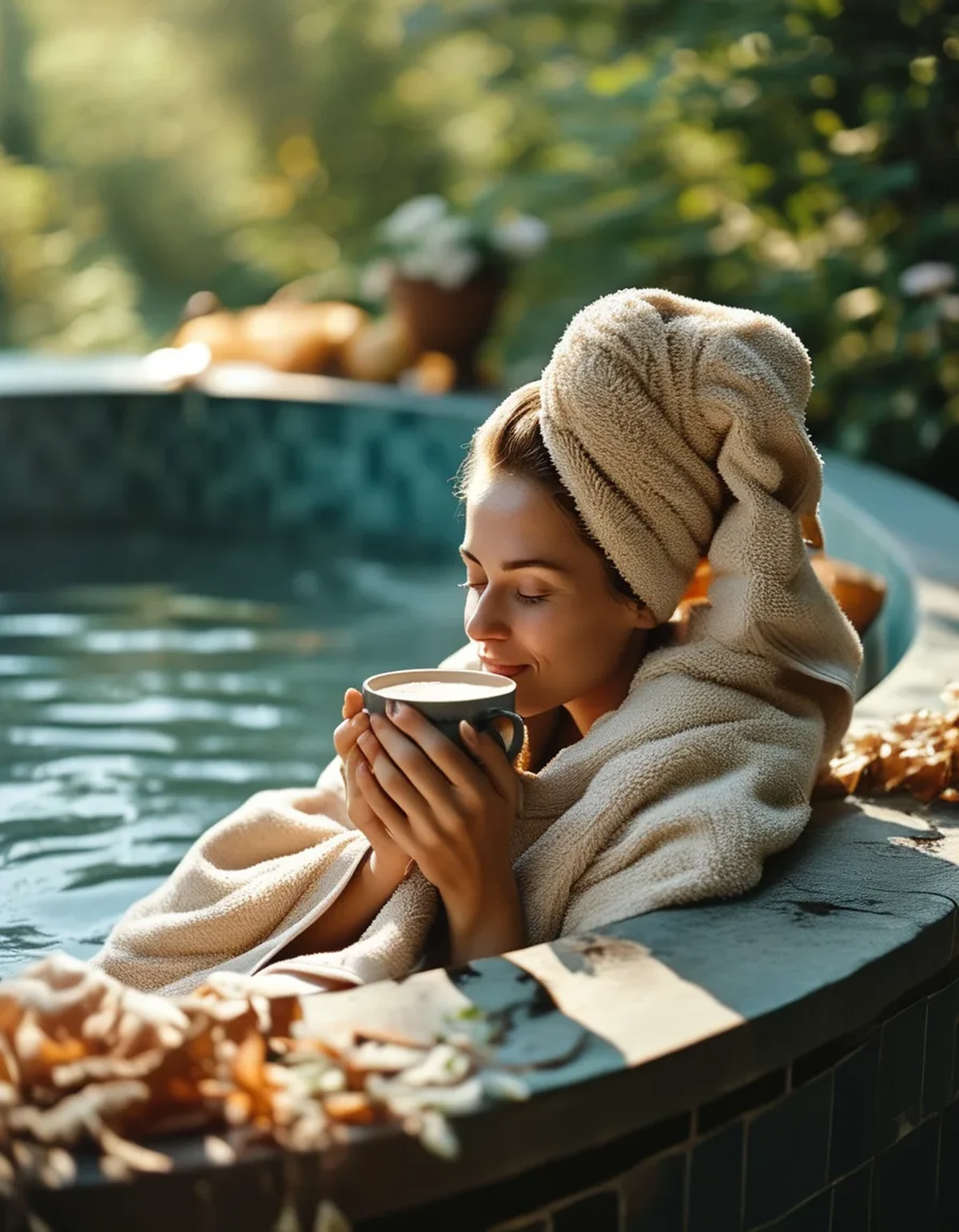
Sauna and hot bathing give you most of what you actually want from recovery work - parasympathetic shift, muscle relaxation, sleep quality, cardiovascular load, and the ritual of a deliberate pause - without any thermal cost. If your reason for cold plunging is stress, sleep, or recovery rather than cold adaptation specifically, heat gets you there and you will actually stick with it.
Contrast therapy, done in the right order. The rule for you is simple and rarely stated: always start on heat and always end on heat. A workable session:
- 8 to 12 minutes warm (sauna, hot bath, or hot shower)
- 45 to 90 seconds cold
- 5 minutes warm again
- Optional second cold round only if the first rewarm was easy
- Finish warm. Non-negotiable.
This gives you the vascular pumping effect that people chase with contrast therapy while keeping you in credit on heat the entire time.
Where cold still earns its place. A brief cold finish to a warm shower - 20 to 30 seconds, face and neck included - is nearly free thermally and still produces a real alertness bump. For many cold-intolerant people this is the entire sustainable cold practice, and it is not a lesser version of anything. It is the version that survives contact with November.
5 Mistakes Cold-Intolerant People Make With Cold Therapy
1. Copying somebody else’s protocol exactly. The three minute, 4C, five days a week template comes from people whose thermal maths is different from yours. Copying the number instead of the effect is the root mistake that produces every other one on this list.
2. Plunging in the morning before eating. Your overnight fast is the low point of your heat production for the day. Cold exposure on an empty stomach hits noticeably harder and rewarming takes longer. Eat something first, even something small - the difference is more obvious than you would expect.
3. Plunging in a cold room. People obsess over water temperature and ignore air temperature. Getting out into a 14C garage undoes everything. Set up the rewarm before you get in: dry towel, dry warm clothes, warm room, hot drink already made. If the plan for afterwards is improvised, it will go badly.
4. Doing it in the evening and wondering why sleep got worse. Cold exposure raises alertness and noradrenaline. That is the point in the morning and a problem at 9pm. If you are still cold at bedtime, your sleep onset will suffer twice - once from the arousal, once from the discomfort.
5. Pushing through shivering because it feels like the honest version. Shivering in the water is not a badge. It is your body burning through its heat reserve, and it predicts a bad afternoon, not a good adaptation. The person who gets out at 70 seconds feeling clear-headed is running a better programme than the person who lasts three minutes and is cold until lunch.
How do you know it is working?
The problem with cold therapy is that the marketed benefits are mostly invisible, so people fall back on duration as the only visible metric - which for you is exactly the wrong one.
The signals that actually indicate a good dose:
- You warm back up within 20 to 30 minutes without heroic measures
- The alertness bump lasts one to three hours rather than becoming a crash
- The dread before getting in decreases over four to six weeks - this is the single most reliable sign of genuine adaptation
- You sleep the same or better that night
- Your hands recover normal colour and sensation within a few minutes of getting out
Signals you have overdone it:
- Cold for more than 40 minutes afterwards
- Appetite spike and fatigue in the afternoon - your body paying back the heat bill
- Getting sick more often across a few weeks of consistent plunging
- Increasing rather than decreasing dread
Give it six weeks before judging. Cold adaptation in people who start cold-intolerant is real but slower - the shift shows up first as a reduced cold-shock breathing response, meaning your breath settles faster on entry, and only later as improved comfort. If you are still gasping at 30 seconds after two months at the same dose, the dose is wrong, not you.
FAQ: Cold Therapy for Cold-Intolerant People, Answered
Will I ever tolerate cold like everyone else?
Partly. The cold-shock response - the gasping and the panic - adapts substantially and fairly quickly, usually inside four to six weeks of consistent exposure. Your rate of heat loss barely changes, because that is body composition and geometry. So it gets much more manageable and never becomes effortless, and that is a normal outcome rather than a failure.
Is it safe if I have Raynaud phenomenon?
This is a conversation for your doctor, not for a blog. Deliberate cold exposure is a known trigger, and some people with Raynaud find cold water genuinely harmful rather than merely uncomfortable. Heat-based recovery is usually the better route. This is general information, not medical advice.
Should I wear gloves or booties in the plunge?
Yes, if that is what makes the session sustainable. It is a common practice among cold-water swimmers and it removes the extremity pain that ends most sessions early, while leaving the core exposure - which is where the effect comes from - intact. Nobody is grading you.
I feel cold all the time even without plunging. Should I be doing this at all?
Work out why first. New or worsening cold intolerance can point to low iron, thyroid changes, or chronic under-eating, and none of those are improved by cold exposure - if anything they are aggravated. Get the baseline checked, then decide.
TL;DR:
- Cold intolerance is physiology - surface area, insulation, vasoconstriction, and metabolic output - not weak mindset
- Start at 12 to 15C for 60 to 90 seconds; add frequency before duration
- Rewarming is the actual skill: dry immediately, layer core first, move gently, allow 20 minutes
- Contrast therapy for you always starts on heat and always ends on heat
- Judge success by rewarm speed and falling dread, never by seconds survived
- New cold intolerance deserves a check for iron, thyroid, and under-eating before any plunging
The standard protocols are written by people who can afford the heat. You cannot, and building a version that respects that is not a compromise - it is the only version you will still be doing in February. Short, warmer, and finished on heat beats heroic and abandoned every time.
Keep Reading
This article is for general informational purposes only and is not medical advice. Always consult a qualified health professional for guidance specific to you.