The Complete Guide to Cold Plunge Water Temperature — What the Numbers Actually Mean
Quick Answer: Most benefits show up between 50-59°F for 2-5 minutes — colder isn’t automatically better, and pushing below 45°F mostly adds risk and discomfort without proportional extra benefit for most healthy adults.
The cold plunge world has a chest-thumping culture around going as cold as possible for as long as possible, but the actual physiology doesn’t reward that the way the culture suggests. This guide walks through what each temperature band is actually doing to your body, so the number on the chiller display means something instead of just being a flex.

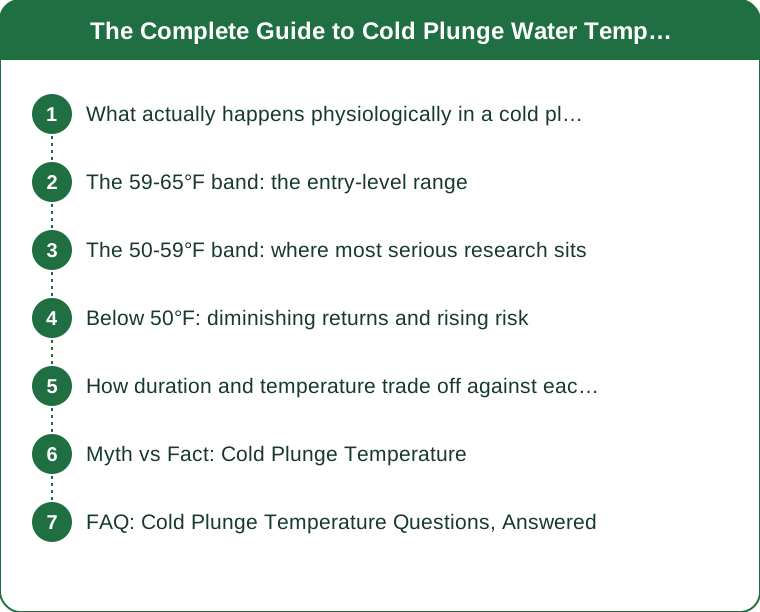
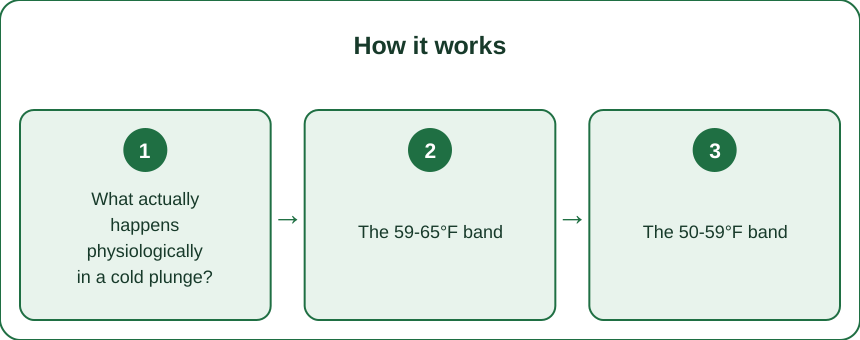
What actually happens physiologically in a cold plunge?
Cold exposure triggers a cascade: peripheral blood vessels constrict to preserve core temperature, norepinephrine and dopamine release increases sharply, and the body shifts into a sympathetic “fight or flight” state briefly before beginning to adapt. This isn’t a single event — it’s a curve, with different temperature bands producing meaningfully different intensities of this response. Below a certain threshold, the response stops scaling usefully and starts just adding physical risk (shivering intensity, numbness, cardiovascular strain) without a matching increase in the adaptations people are actually seeking, like mood elevation or inflammation modulation.
The 59-65°F band: the entry-level range
This range is genuinely cold enough to trigger a real sympathetic response and norepinephrine release, but mild enough that sessions of 3-5 minutes feel manageable even for first-timers. Most of the mood and alertness benefits people report from cold exposure are achievable in this range — it’s not a compromise zone, it’s a legitimate and often underrated starting point that many experienced plungers eventually return to for regular maintenance use rather than pushing colder indefinitely. For anyone new to cold exposure, or anyone with any cardiovascular caution, this is the responsible starting range, and staying here for the first several weeks lets the body adapt gradually rather than being shocked into a stress response that discourages consistency.
The 50-59°F band: where most serious research sits
This is the range most commonly used in published cold-water immersion research, generally for 2-5 minute sessions. It produces a noticeably stronger norepinephrine spike than the milder band above, and this is where most people report the most reliable mood and alertness effects relative to the discomfort involved. It’s also cold enough that breath control becomes genuinely important — the gasp reflex is strong here, and learning to control breathing through the first 30-45 seconds is a real skill that develops with repeated exposure, not something that should be assumed on a first attempt. Many experienced practitioners consider this their long-term working range rather than something to graduate away from toward colder water.

Below 50°F: diminishing returns and rising risk
Once water drops below 50°F, and especially below 45°F, the physiological response intensifies, but not in a way that translates to proportionally more benefit. Instead, this range meaningfully raises cardiovascular strain (the cold shock response taxes the heart more), increases risk of hyperventilation-driven panic response, and shortens safe exposure time dramatically — often to well under 2 minutes for anyone without extensive cold-adaptation experience. The extra discomfort in this range is frequently a badge-of-honor pursuit more than a physiologically justified one; the adaptations people are chasing (mood, alertness, inflammation modulation) are largely already accessible in the 50-59°F band without the added cardiovascular load.
How duration and temperature trade off against each other
Temperature and time aren’t independent — a colder plunge should always come with a shorter duration, and this relationship is easy to get backwards when chasing either number for its own sake. A useful mental model: 60°F might support 5 minutes comfortably, 55°F suits about 3 minutes, and 48°F or colder should be limited to under 2 minutes even for experienced people. Trying to hold a long duration at an aggressively cold temperature is the combination most associated with genuine risk, not just discomfort, and it’s the single most common mistake people make once they’ve built some tolerance and start pushing both variables at once instead of just one.
Myth vs Fact: Cold Plunge Temperature
Myth: Colder water always means better results. Fact: Benefits plateau around 50-59°F for most people — colder mainly adds risk and shortens safe duration without proportional extra benefit.
Myth: You should push toward the coldest temperature you can tolerate. Fact: Tolerance and physiological benefit aren’t the same curve — tolerance can keep climbing while benefit has already flattened out.
Myth: Ice is necessary for a cold plunge to work. Fact: Tap-cold water in the 55-60°F range triggers a real, measurable response — ice-level cold isn’t required to get meaningful effects.
This is general information, not medical advice — check with a doctor before starting cold exposure, especially with any cardiovascular condition.
FAQ: Cold Plunge Temperature Questions, Answered
What’s the best beginner cold plunge temperature?
59-65°F for 2-3 minutes is a realistic, sustainable starting point that still triggers a genuine physiological response without overwhelming a first-timer.
Is it better to go colder for less time or milder for longer?
Milder for a slightly longer duration (within reason) is generally the more sustainable approach for building consistency, since colder-and-longer stacks risk without proportional benefit.
Do I need special equipment to hit a specific temperature?
A chiller unit gives precise control, but a tub with ice and a thermometer works fine for consistent 50-59°F sessions without additional equipment.
TL;DR:
- Most benefits cluster in the 50-59°F range for 2-5 minutes
- Below 50°F adds cardiovascular strain and risk without proportional extra benefit
- Colder water should always mean shorter duration, not longer
- 59-65°F is a legitimate long-term range, not just a beginner compromise
This is general information, not medical advice.
Keep Reading
This article is for general informational purposes only and is not medical advice. Always consult a qualified health professional for guidance specific to you.