Cold Plunge for Beginners: How to Start Cold-Water Immersion Safely (and Why People Swear By It)
Quick Answer: To do a cold plunge correctly as a beginner, start with 30–60 second cold showers for a week or two, then move to water around 55–60°F (13–15°C) for 1–2 minutes, breathing slowly the whole time. Never plunge alone in open water, rewarm gradually afterward, and get medical clearance first if you have any heart or blood-pressure condition.
The first ten seconds are genuinely awful. Your breath catches, your shoulders climb toward your ears, and every instinct says get out.
That reaction — the cold shock response — is the whole reason the practice works and the whole reason it can be dangerous. Here’s how to start without learning that the hard way. (Not medical advice.)

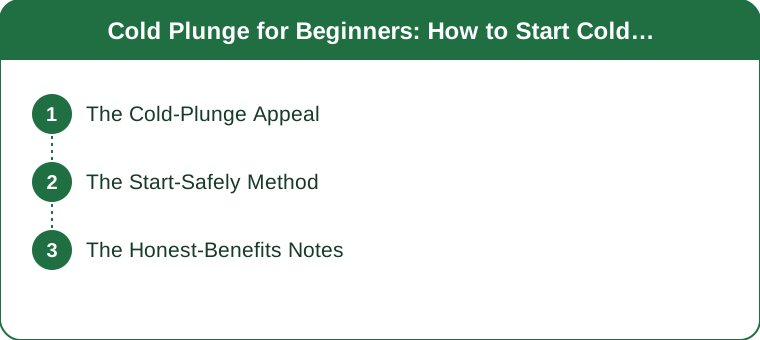
Why Do People Swear By Cold Plunging?
The alertness hit is immediate and undeniable. Cold water triggers a sharp surge of noradrenaline, and the “awake” feeling that follows lasts well past the plunge itself. This is the part almost nobody disputes.
The mood effect is the reason people keep going. Regular cold-water users consistently describe a lifted, clear-headed feeling for hours afterward. It’s the most reliably reported benefit after alertness.
The resilience angle is real, if less measurable. Choosing something uncomfortable on purpose, every morning, before anything else has gone wrong — that has a psychological weight that’s hard to quantify but easy to feel.
Recovery is the murkiest claim. Cold immersion after hard training does reduce soreness for many people, but the evidence is mixed and there’s a specific catch covered below.
How Do You Do a Cold Plunge Correctly, Step by Step?
Week 1–2: cold showers. End your normal shower with 30 seconds of cold. Build to 60–90 seconds. This is not a warm-up phase you skip — it’s where you learn to control your breathing while your body is screaming.
Week 3: your first real immersion. Aim for water around 55–60°F (13–15°C) and 60–90 seconds. Moderate cold first. Ice-bath temperatures (below 50°F / 10°C) are not a beginner’s starting point.
Get in deliberately, not heroically. Feet, legs, waist, then shoulders. Don’t jump — a sudden full-body plunge maximizes the shock response, which is exactly what you don’t want while you’re still learning.
Control the breath. Long, slow exhales, longer out than in. If you can hold a steady breathing rhythm, you’re in control. If you can’t, get out — that’s the signal, not a challenge.
Build to 2–3 minutes, then stop chasing time. Most of the reported benefit shows up in the first couple of minutes. Ten-minute plunges buy you bragging rights and hypothermia risk, roughly in that order.
Rewarm gradually. Dry off, put on layers, move around gently, have something warm. Skip the scalding shower immediately after — a fast rewarm can drop your core temperature further as cold blood returns from the limbs.

What Are the Real Safety Rules?
- Never alone in open water. Cold shock can cause involuntary gasping in the first seconds — inhale underwater and it’s over fast. Open water is a different category of risk from a tub in your garage. Bring a person.
- Clear it medically first. Cold immersion spikes blood pressure and heart rate. Heart conditions, uncontrolled hypertension, arrhythmias, Raynaud’s, or pregnancy all deserve a conversation with your doctor before you start.
- Don’t drink and plunge. Alcohol blunts your judgment about how cold you actually are.
- Watch for the exit signals. Uncontrollable shivering, numbness that spreads, slurred speech, or a loss of coordination all mean out — immediately.
- Don’t stack it with a sauna until you’re comfortable in both. Contrast therapy is great; it’s just not a day-one protocol.
5 Mistakes Everyone Makes
- Starting too cold. People fill a tub with ice on day one, hate it, and quit by day four. The third mistake on this list is the one that surprises even experienced lifters.
- Chasing duration. Longer isn’t better past a few minutes. It’s just colder.
- Plunging right after a heavy lifting session. Cold immediately after resistance training may blunt the muscle adaptation you just worked for. If you lift and plunge on the same day, separate them by 4–6 hours, or plunge before training rather than after.
- Rewarming with scalding water. Feels great, undermines the gradual rewarm your body needs.
- Going alone in a lake because the tub felt easy. A controlled tub and open water are not the same activity.
What’s Real and What’s Hype?
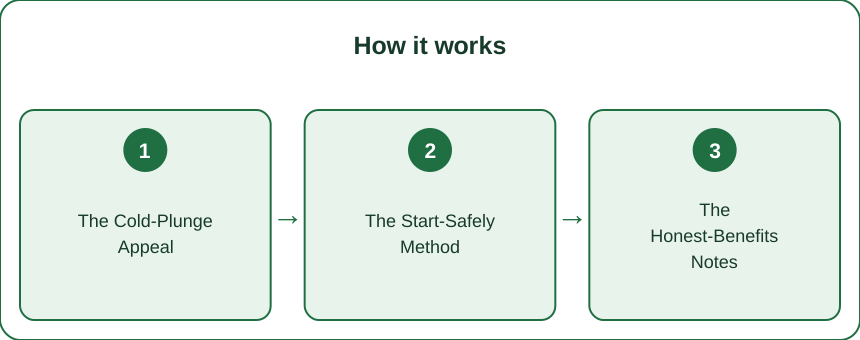
Honest scorecard: alertness and mood — well supported by consistent reports and plausible mechanism. Mental resilience — real, if subjective. Soreness reduction — mixed evidence, works for some. Muscle-gain interference after lifting — a genuine caveat worth timing around. Fat loss, immune boosting, metabolic transformation — heavily oversold.
Cold plunging is a good tool with a narrow, real set of benefits. It is not a substitute for sleep, training, or eating properly, and anyone selling it as one is selling something.
FAQ
Is a cold shower as good as a cold plunge?
Not identical — a plunge immerses more surface area and cools you faster — but a cold shower delivers a large share of the alertness and mood effect and is the correct place to begin. Many people never progress past showers and still get most of what they came for.
How cold should the water actually be?
Beginners: 55–60°F (13–15°C). Experienced: 50–59°F (10–15°C) is the common range. Below 50°F is advanced territory and shortens safe exposure time considerably.
How often should you do it?
Two to four sessions a week is a reasonable target. Daily is fine for many people once they’ve adapted, but it’s not required for the mood and alertness benefits.
When should you see a professional?
Talk to a doctor before starting if you have any cardiovascular condition, high or unstable blood pressure, a history of fainting, Raynaud’s, diabetes with neuropathy, or you’re pregnant. Stop and seek help for chest pain, confusion, or shivering that won’t stop after rewarming.
TL;DR:
- Start with 30–60 second cold showers for one to two weeks before any tub.
- First plunges: 55–60°F (13–15°C), 60–90 seconds, entering gradually.
- Slow exhales are the whole technique; losing breath control means get out.
- Cap it around 2–3 minutes — longer adds risk, not benefit.
- Never plunge alone in open water; rewarm gradually, not with scalding water.
- Alertness and mood are the real wins; recovery evidence is mixed, and cold right after lifting may blunt gains.
- Get medical clearance for any heart, blood-pressure, or circulation condition. Not medical advice.
Keep Reading
This article is for general informational purposes only and is not medical advice. Always consult a qualified health professional for guidance specific to you.